Le Creuset Stainless Steel Saucier: Worth It?
For home cooks in the United States, the Le Creuset stainless steel saucier is a versatile pan for making sauces, custards, risotto, caramel, soup, and small pasta dishes. Its rounded cooking surface helps a whisk or spatula reach the edges, while its stainless steel body offers a durable, nonreactive surface.
The pan is a strong fit for cooks who want one high-quality vessel for stove-to-oven cooking and do not mind using a little technique to prevent sticking. It is less suitable for anyone who wants the easy release of a coated nonstick pan.
This guide explains what the Le Creuset stainless steel saucier does well, how to use it, how to clean it, and which trade-offs matter before buying one in the U.S.

Quick Answer: Is the Le Creuset Stainless Steel Saucier Worth It?
The Le Creuset stainless steel saucier is worth considering if you need a rounded, uncoated pan for controlled cooking. The shape is especially useful for sauces and foods that require frequent stirring or whisking.
Its main benefits are:
- A rounded interior that reduces hard-to-reach corners
- Stainless steel cooking surfaces with no synthetic coating
- Multi-layer construction designed to spread heat
- Compatibility with common U.S. cooktops, including induction models when the product version is marked induction-compatible
- Oven and broiler use within the limits listed by Le Creuset
- A design that works for both delicate sauces and higher-heat browning
The main drawbacks are its premium price, heavier feel compared with thin cookware, and the learning curve of cooking on uncoated stainless steel. It also does not provide the effortless release of a nonstick saucier.

What Is a Stainless Steel Saucier?
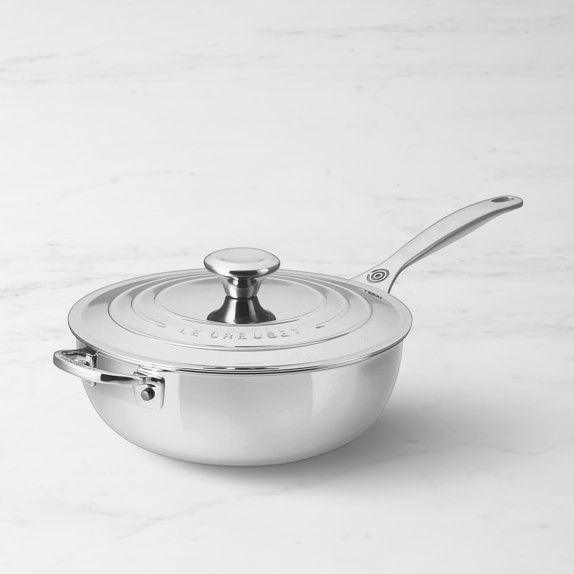
A saucier is a pan with sloped or rounded sides and a broad base. Unlike a traditional saucepan, it does not have a sharp corner where the base meets the wall.
That shape serves a practical purpose. A whisk, wooden spoon, or silicone spatula can move across more of the cooking surface. This helps when you are:
- Reducing cream or stock
- Making béchamel or cheese sauce
- Cooking risotto
- Preparing pastry cream
- Melting butter and sugar
- Finishing pasta in sauce
- Deglazing after browning meat
The Le Creuset stainless steel saucier is different from Le Creuset’s enameled cast iron cookware. It does not have a colored enamel coating over cast iron. Instead, it uses stainless steel and a layered metal design intended to improve heat distribution.
Stainless steel is also nonreactive with most acidic foods. That makes it useful for tomato sauces, wine reductions, citrus-based sauces, and fruit preparations.

Le Creuset Stainless Steel Saucier Construction and Design
Le Creuset’s stainless steel cookware line uses multi-layer construction. In this type of pan, stainless steel surrounds a heat-conductive metal core, commonly aluminum. The outer layer is designed to work with the cooking surface, while the inner core helps move heat across the base and sides.
The practical effect is more important than the layer count: the pan should heat more evenly than a thin, single-layer stainless steel pan. Even so, no cookware eliminates hot spots entirely. Burner size, heat level, pan position, and the food inside the pan still affect results.
Rounded cooking surface
the rounded interior is the defining feature of a saucier. It lets a whisk follow the curve of the pan without leaving flour, butter, or sauce in a narrow corner.
This is most useful for foods that can scorch or clump. A sauce may look smooth in the center while a thin layer sticks along the edge. The saucier shape gives you better access to that edge.
Stainless steel interior
The cooking surface is uncoated stainless steel. It will not gradually wear away like a traditional nonstick coating, but it can discolor or develop stuck-on food if used incorrectly.
Stainless steel also has no added nonstick layer. You must preheat the pan, use enough fat when needed, and avoid moving food too soon when searing.
Handle and lid considerations
The specific handle, lid, and capacity can vary by model and market. U.S. listings may also change over time. Before ordering, confirm:
- The exact pan capacity
- Whether a lid is included
- The stated oven temperature limit
- Broiler guidance
- Induction compatibility
- Warranty terms
- Current dimensions and weight
Do not assume that every Le Creuset stainless steel pan has the same specifications. Product families often include several shapes and sizes.

How to Use the Le Creuset Stainless Steel Saucier
The best results come from matching the heat level to the food. Stainless steel responds well to controlled heat, but excessive heat can cause browning, scorching, or stubborn residue.
1. Preheat the pan gradually
Place the empty saucier on the burner over low or medium heat. Give it time to warm before adding oil or ingredients.
A simple water test can help. Sprinkle a few drops of water into the pan. If the drops sit still, the pan may be too cool. If they evaporate at once, it may be too hot. Water that forms small beads and moves across the surface usually indicates a hotter cooking surface.
Dry the pan before adding oil. Water and hot oil can splatter.
2. Add the right amount of fat
For sautéing, browning, or cooking eggs, add oil or butter after the pan has warmed. Swirl it across the base.
Use less heat than you might use with a thin pan. The layered metal construction can retain and spread heat after the burner is lowered.
3. Let food release naturally
When searing meat, fish, or vegetables, food may stick at first. That does not always mean the pan has failed.
Food often releases when the surface has browned. Trying to turn it too early can tear the food and leave more residue behind.
4. Lower the heat for sauces
Once a sauce begins to simmer, reduce the heat. A rolling boil can cause cream sauces to split, custards to curdle, and reductions to thicken too fast.
The rounded base makes whisking easier, but it does not replace careful heat control. Stir frequently when cooking thick mixtures.
5. Deglaze while the pan is warm
After browning food, remove excess fat if needed. Add wine, stock, water, or another suitable liquid while the pan is warm.
Use a wooden or silicone utensil to loosen browned bits. Avoid adding cold liquid to an extremely hot pan if the product instructions warn against thermal shock. A sudden temperature change can stress cookware.
Signs you are using the pan correctly
You should see:
- Even bubbling rather than violent boiling
- Sauce that thickens at a steady rate
- Food that releases after browning
- Little or no smoke from the cooking fat
- Residue that softens with soaking and normal cleaning
If food burns often, lower the heat before changing your technique. High heat is one of the most common causes of poor stainless steel results.

Best Uses for the Le Creuset Saucier
The saucier shape is most valuable when the food needs constant movement, smooth texture, or edge-to-edge scraping.
Sauces and gravies
A saucier is well suited to:
- Béchamel
- Hollandaise
- Velouté
- Pan gravy
- Tomato cream sauce
- Wine reduction
- Caramel sauce
- Chocolate sauce
The rounded base helps prevent unmixed flour or dairy from hiding in a corner. Use low to medium heat and whisk often.
Risotto and grains
The wide base gives rice more contact with the cooking surface. The rounded sides also make stirring easier.
For risotto, add warm stock in stages and stir as needed. The pan can help produce an even texture, but the result still depends on rice type, liquid amount, and cooking time.
Custards and pastry fillings
Stainless steel is useful for pastry cream, lemon curd, pudding, and other cooked fillings. The metal surface does not retain food odors or flavors in the way some porous materials can.
Use gentle heat. A thick custard can scorch quickly, even in a well-made pan. Stir across the bottom and into the curved sides.
Pasta finishing
A saucier can finish pasta in its sauce because the broad, rounded base gives you room to toss and stir. Reserve some pasta water before draining. Its starch can help bind the sauce.
Do not fill the pan beyond a safe level. A smaller saucier is better for one or two portions; a larger size is more practical for family meals.
Saucier vs. Saucepan: Which Shape Should You Choose?
Choose a saucier when stirring access and sauce texture matter most. Choose a saucepan when you need more vertical capacity, a narrow footprint, or a traditional shape for boiling and reheating.
| Feature | Saucier | Saucepan |
|---|---|---|
| Interior shape | Rounded or sloped | More vertical sides |
| Stirring access | Very good | Good, but corners are sharper |
| Sauce reduction | Broad surface can speed reduction | Often slower in a narrower base |
| Large liquid volume | Usually less efficient | Often better |
| Rice and risotto | Convenient for stirring | Works, but may need more scraping |
| Storage | May take more shelf space | Often stacks more easily |
| Best for | Sauces, custards, reductions | Boiling, reheating, soups, grains |
The right choice depends on your cooking pattern. If you often make sauces from scratch, the saucier shape has a clear advantage. If you mainly boil eggs, heat soup, or cook oatmeal, a standard saucepan may offer better value.

Is Stainless Steel Safe for Acidic Foods?
High-quality stainless steel cookware is commonly used for acidic foods such as tomatoes, vinegar-based sauces, citrus, and wine. It is generally valued because it does not react easily with these ingredients.
However, avoid storing highly acidic food in the pan for long periods. Transfer leftovers to a suitable food-storage container after cooking. Long storage can affect flavor, cause discoloration, and make cleaning harder.
Do not use steel wool, harsh scouring powders, or abrasive tools unless the product care instructions specifically allow them. Scratches do not usually make stainless steel unusable, but aggressive cleaning can damage the finish.
If you have a known metal allergy or a medical concern about cookware materials, ask a qualified health professional for advice based on your situation.

How to Clean the Le Creuset Stainless Steel Saucier
Clean the saucier after it has cooled enough to handle. Do not place a very hot pan under cold water. A sudden temperature change can warp cookware or stress its components.
Follow this sequence:
- Remove loose food with warm water and a soft sponge.
- Add a small amount of dish soap.
- Soak the pan if food has dried.
- Use a nonabrasive pad for stubborn residue.
- Rinse well and dry fully.
For brown or cloudy marks, a stainless steel cleaner or a mild paste made for cookware may help. Follow Le Creuset’s care directions and test any cleaner on a less visible area first.
For burned food, fill the pan with enough water to cover the residue. Simmer the water gently, turn off the heat, and let the pan cool. The softened residue may then lift with a wooden or silicone tool.
Avoid these common mistakes:
- Putting a hot pan under cold running water
- Leaving salty water to evaporate in the pan
- Using chlorine bleach
- Cutting food inside the pan
- Scrubbing with sharp metal tools
- Stacking the pan against rough cookware without protection
Some stainless steel models are dishwasher safe according to manufacturer instructions, but hand washing usually helps preserve the finish. Always check the care guide for your exact U.S. model.

Common Problems and Fixes
Food sticks to the pan
Likely causes: The pan was too cool, the food was moved too soon, or there was too little cooking fat.
Fix: Preheat gradually, add the fat, and wait for food to brown before turning it. For delicate foods, use moderate heat and enough fat to create a thin cooking film.
The pan develops rainbow marks
Likely cause: Heat discoloration or mineral deposits from water.
Fix: Use a cleaner intended for stainless steel. These marks are usually cosmetic, but abrasive cleaning can create new scratches.
Sauce burns on the bottom
Likely causes: Heat is too high, the sauce is too thick, or it is not stirred often enough.
Fix: Lower the heat, add liquid if the recipe allows, and scrape the bottom and sides with a silicone spatula. For custards and dairy sauces, use the lowest heat that maintains gentle cooking.
The outside base changes color
Likely cause: High heat, burner residue, or contact with a larger burner than the base.
Fix: Match the burner to the pan base and clean the exterior with an appropriate nonabrasive product. Exterior discoloration does not automatically mean the pan is unsafe.
The pan feels too heavy
A layered stainless steel saucier can weigh more than thin aluminum or coated cookware. This is a trade-off, not necessarily a defect. If wrist strength or lifting comfort is a concern, compare the listed weight before buying and consider a smaller capacity.

What to Check Before Buying in the United States
Before purchasing a Le Creuset stainless steel saucier, compare the exact listing rather than relying only on the product name.
Check the following:
- Capacity: Match it to the number of servings you usually cook.
- Diameter: Confirm that it fits your burners and storage space.
- Induction use: Look for explicit induction compatibility.
- Oven limit: Follow the current manufacturer limit for the pan, lid, and handle.
- Broiler use: Do not assume that a pan rated for oven use is also safe under a broiler.
- Lid inclusion: Some listings may sell lids separately or use different package contents.
- Return policy: A premium pan should arrive without dents, sharp edges, or a warped base.
- Warranty: Keep proof of purchase and review the U.S. warranty terms.
- Price: Compare the current price with similar multi-layer stainless steel sauciers, not with basic single-layer pans.
A higher price can reflect construction, design, finish, and warranty support. It does not guarantee that the pan will suit every cook or outperform every competing pan in every task.

Le Creuset Saucier Alternatives
The best alternative depends on the feature you value most.
For lower cost
A basic stainless steel saucier from another cookware brand may provide the same rounded shape at a lower price. Check whether it has a bonded aluminum core, a flat base, an induction-compatible exterior, and a useful warranty.
For easy food release
A nonstick saucier is easier for eggs, delicate fish, and low-fat cooking. Its coating has a limited service life and may require lower heat and gentler utensils.
For maximum heat retention
An enameled cast iron braiser or saucepan holds heat well and works for slow cooking. It is much heavier and usually less responsive when you need to change temperature quickly.
For light weight
A hard-anodized aluminum pan is often easier to lift. Confirm whether it has a coating and whether the exact model works on induction.
The Le Creuset stainless steel saucier sits between these options: it offers a durable uncoated surface and good heat control, but it asks the cook to manage temperature and cleaning more carefully.

Key Takeaways
- The Le Creuset stainless steel saucier is designed for sauces, custards, reductions, risotto, and other foods that need frequent stirring.
- Its rounded interior is the main advantage over a standard saucepan.
- Stainless steel is durable and nonreactive with most common cooking ingredients, but it is not naturally nonstick.
- Gradual preheating, moderate heat, and timely stirring reduce sticking and scorching.
- Confirm the exact U.S. model’s capacity, induction rating, oven limit, lid details, and care instructions before buying.
- A saucier is a poor value if you mainly need a tall pan for boiling or a nonstick surface for low-fat cooking.
Frequently Asked Questions
Is the Le Creuset stainless steel saucier nonstick?
No. It has an uncoated stainless steel cooking surface. Food release improves when you preheat the pan, use suitable fat, control the heat, and wait for browned food to release naturally.
Can the Le Creuset stainless steel saucier go in the oven?
Many Le Creuset stainless steel cookware models are designed for oven use, but the temperature limit can vary by model and component. Check the current U.S. product instructions before using the pan, lid, or handle in the oven or under a broiler.
Is it compatible with induction cooktops?
Many stainless steel models are induction-compatible. Confirm that the exact saucier listing states induction compatibility. Do not rely on the general Le Creuset brand name alone.
What size saucier should I buy?
Choose a smaller capacity for sauces, custards, and one- or two-person portions. Choose a larger capacity if you regularly make risotto, pasta sauce, gravy, or family-size meals. Also compare the pan’s diameter with your burner size and storage space.
Why does stainless steel discolor?
Rainbow marks, white spots, and brown stains usually come from heat, minerals in water, oil, or cooked-on residue. They are often cosmetic and can usually be reduced with a stainless steel-safe cleaner and a soft pad.
Can I use metal utensils in the pan?
Uncoated stainless steel generally tolerates metal utensils better than nonstick cookware. However, sharp tools can scratch the finish and may damage the pan’s appearance. Silicone, wood, or smooth-edged utensils are gentler choices.
Conclusion: Who Should Buy the Le Creuset Stainless Steel Saucier?
The Le Creuset stainless steel saucier is a strong choice for U.S. cooks who make sauces, custards, reductions, risotto, or pasta often. Its rounded shape improves stirring access, and its uncoated stainless steel surface is built for long-term use when cared for properly.
It is not the best choice for everyone. Pick a nonstick saucier if easy release is your top priority, a standard saucepan if you need more height, or a less expensive stainless steel model if the Le Creuset price exceeds your budget.
Before purchasing, verify the exact U.S. model’s capacity, dimensions, induction compatibility, oven rating, lid, warranty, and care instructions. That final check matters more than the brand name alone.

Hi, I’m Mary, the founder of KitchenClue.com. I’m deeply passionate about everything that makes a kitchen smarter, easier, and more enjoyable. I share hands-on insights and practical expertise on kitchen gear that truly helps in daily cooking. Along with my dedicated research team, we study products carefully, and our writers create honest, well-tested reviews using trusted, authentic sources—so you can choose kitchen tools with total confidence.