Le Creuset Wine Opener Screwpull: Best Buying Guide
Introduction
For wine drinkers in the United States, a Le Creuset wine opener Screwpull can make opening a bottle easier, faster, and more controlled than a basic waiter’s corkscrew. The Screwpull name refers to Le Creuset’s line of lever-style, pocket, and traditional wine openers.
The right model depends on your needs. A lever opener suits home use and frequent entertaining. A compact pocket model works well for travel. A classic corkscrew offers the lowest cost and easiest storage.
This guide explains how Le Creuset Screwpull wine openers work, how to use them, how to fix common problems, and what to check before buying a new one or replacing an older model.

What Is a Le Creuset Screwpull Wine Opener?
A Le Creuset Screwpull wine opener is a corkscrew designed to remove wine bottle corks with less pulling force. Most models use a metal spiral, called a worm, that enters the cork. The handle or lever then lifts the cork from the bottle neck.
The Screwpull range has included several designs over time:
- Lever-style openers: Use a long handle and a lifting action.
- Table or countertop models: Sit on a base and provide added stability.
- Pocket openers: Fold or collapse for travel and storage.
- Traditional corkscrews: Use a simple turning motion.
- Foil cutters: Remove the capsule that covers the cork before opening.
The exact design, included parts, and replacement options can vary by model and production year. Older Screwpull openers may look different from models sold by Le Creuset today.
The central advantage is mechanical leverage. The opener converts hand movement into upward force, so the user does not need to yank the cork straight out.
How Does the Screwpull Mechanism Work?
A Screwpull opener works by combining a sharp spiral with leverage. The spiral must enter the cork near its center. Once the worm has a firm grip, the handle or lever pulls the cork upward along the bottle’s neck.
This design helps in three ways:
- It reduces hand strain. Leverage does much of the lifting.
- It helps keep the bottle steady. Some models hold the bottle neck or rest on a base.
- It can lower the chance of cork breakage. A centered, steady pull is gentler than a sudden tug.
The cork’s condition still matters. A dry, crumbly, damaged, or very old cork can break even when the opener works correctly. Synthetic corks may also feel tighter because they do not compress in the same way as natural cork.
A Screwpull opener is not a wine preservation system. It opens the bottle, but it does not stop oxidation after the cork is removed.

How to Use a Le Creuset Screwpull Wine Opener
The steps differ slightly by model, but the basic method is consistent.
1. Remove the foil
Use a foil cutter or a small, safe cutting tool to remove the capsule from the top of the bottle. Cut below the raised lip if possible.
Do not force the opener through thick foil. The foil can block the worm, make the opener sit off-center, and increase the chance of a broken cork.
2. Place the opener over the cork
set the worm directly above the center of the cork. Keep the opener vertical.
Centering is one of the most important steps. If the worm enters near the edge, it can split the cork or push it into the bottle.
3. Drive the worm into the cork
Turn the handle or operate the lever according to the model’s design. Apply steady pressure rather than quick force.
Stop when the worm has entered deeply enough to hold the cork. On many openers, the worm should go through most of the cork but should not be driven aggressively into the wine.
4. Lift the cork slowly
Use the lever or handle to raise the cork. Keep the bottle upright and stable.
A slow lift gives the cork time to release from the glass. If the cork resists, pause and check that the worm is centered and fully engaged.
5. Remove the cork from the worm
Once the cork is out, hold it firmly and reverse the handle or rotate the cork from the worm. Avoid twisting the cork sideways, since this can cause it to crumble.
Signs of a successful opening
- The cork comes out in one piece.
- The bottle remains stable.
- The worm stays centered in the cork.
- No glass, cork dust, or foil enters the wine.
- The bottle lip remains clean and undamaged.
If a cork begins to crack, stop pulling. A second, careful attempt may remove the remaining portion more cleanly than continued force.
Which Le Creuset Screwpull Model Is Right for You?
The best Screwpull model depends more on use than on appearance. Use this comparison as a starting point.
| Opener type | Best for | Main benefit | Main limitation |
|---|---|---|---|
| Lever model | Regular home use and entertaining | Low-effort opening | Takes more storage space |
| Table model | Frequent bottle opening | Strong stability and leverage | Less portable |
| Pocket model | Travel, picnics, and small kitchens | Compact size | Requires more hand control |
| Traditional corkscrew | Occasional use and low budgets | Simple and easy to store | More effort for tight corks |
| Foil cutter plus opener set | Gift giving or complete setups | Convenient matching tools | More parts to store |
Choose a lever model if ease matters most
A lever opener is a practical choice for people who open wine often or have limited hand strength. The long handle creates more leverage than a short, basic corkscrew.
It is also useful when serving several bottles during a meal. However, large lever models may not fit well in a small kitchen drawer.
Choose a pocket model if portability matters
A pocket Screwpull is useful for travel and outdoor meals. Its smaller size makes it easier to carry in a picnic bag or suitcase.
The trade-off is control. Compact openers usually require more direct hand pressure and may be less comfortable with hard synthetic corks or fragile older corks.
Choose a table model for stability
A countertop opener can be a good fit for frequent hosts, tasting rooms, or people who prefer to use both hands for bottle control.
Before buying one, check the available counter space and the model’s size. A stable opener is helpful only if it can remain securely positioned during use.
What to Check Before Buying a Screwpull Opener
Before purchasing a Le Creuset wine opener Screwpull, check the following details.
Confirm the exact model
“Screwpull” covers multiple designs. Search for the model name, product code, or a clear photograph before ordering accessories or replacement parts.
Two openers may look similar but use different worms, handles, capsules, or mounting systems.
Check the condition of the worm
The worm should be straight, firmly attached, and free of heavy rust or damage. A bent worm can enter the cork at an angle and cause breakage.
If the spiral is loose, do not continue using the opener until it is repaired or replaced.
Consider replacement support
Older wine openers may have limited access to replacement worms or parts. Check the manufacturer’s current support information and the seller’s return policy before buying a used model.
A low-priced vintage opener may not be a good value if a damaged worm cannot be replaced.
Compare storage needs
Measure the space where you plan to keep the opener. Countertop models can be convenient, but they may be too large for a crowded kitchen.
For drawers or travel bags, a folding or pocket model is usually more practical.
Avoid judging by appearance alone
A polished finish does not show how well an opener will handle a fragile cork. Function depends on the worm, alignment, leverage, condition, and user technique.
If possible, prioritize model documentation and replacement support over color or finish.

Troubleshooting Common Screwpull Problems
Most opening problems come from cork condition, poor alignment, or a damaged worm. Check the simplest and safest causes first.
The cork breaks
Likely causes:
- The cork was old, dry, or damaged.
- The worm entered near the edge.
- The worm did not go deep enough.
- The opener was pulled at an angle.
What to do:
- Stop pulling when the cork starts to split.
- Recenter the worm on the remaining cork.
- Insert it slowly and straight.
- Lift with steady pressure.
If cork pieces fall into the wine, pour the wine through a clean fine-mesh strainer or decant it carefully. Do not use a damaged opener that sheds metal or has a loose spiral.
The worm spins without lifting the cork
The worm may not have entered deeply enough, or the cork may be unusually hard. Remove the opener, inspect the spiral, and try again from the center.
Do not force the handle if the worm is bent. Excess force can damage the opener or the bottle.
The opener slips off the bottle
Check for leftover foil, a wet bottle neck, or incorrect placement. Remove all foil from the opening area and wipe the neck dry.
For a lever model, make sure the opener is seated evenly over the bottle. Keep the bottle on a stable, level surface.
The cork falls into the bottle
This can happen with a brittle cork or when the worm passes completely through it. Pour the wine through a clean strainer before serving.
Do not shake the bottle to remove the cork. Shaking can spread cork fragments and disturb the wine.
The handle or lever feels loose
Stop using the opener until you inspect the fasteners and moving parts. A loose handle can change the pulling angle and may make the bottle unstable.
If the part cannot be tightened safely, contact Le Creuset support or replace the opener. Avoid makeshift repairs near the bottle neck.
Cleaning and Maintaining a Le Creuset Wine Opener
Basic care helps preserve the worm and moving parts.
- Wipe the worm after use with a clean, damp cloth.
- Dry the opener before storing it.
- Remove cork dust from joints and grooves.
- Do not soak a lever mechanism unless the manufacturer permits it.
- Avoid abrasive cleaners that can damage the finish.
- Do not place the opener in a dishwasher unless the product instructions specifically allow it.
- Store the worm where it will not bend or strike other utensils.
Do not use cooking oil on the worm unless the manufacturer recommends it. Oil can collect cork dust and may transfer an unwanted taste or residue.
If the opener has a removable worm, replace it when it becomes bent, dull, heavily corroded, or loose. A replacement part must match the exact model.
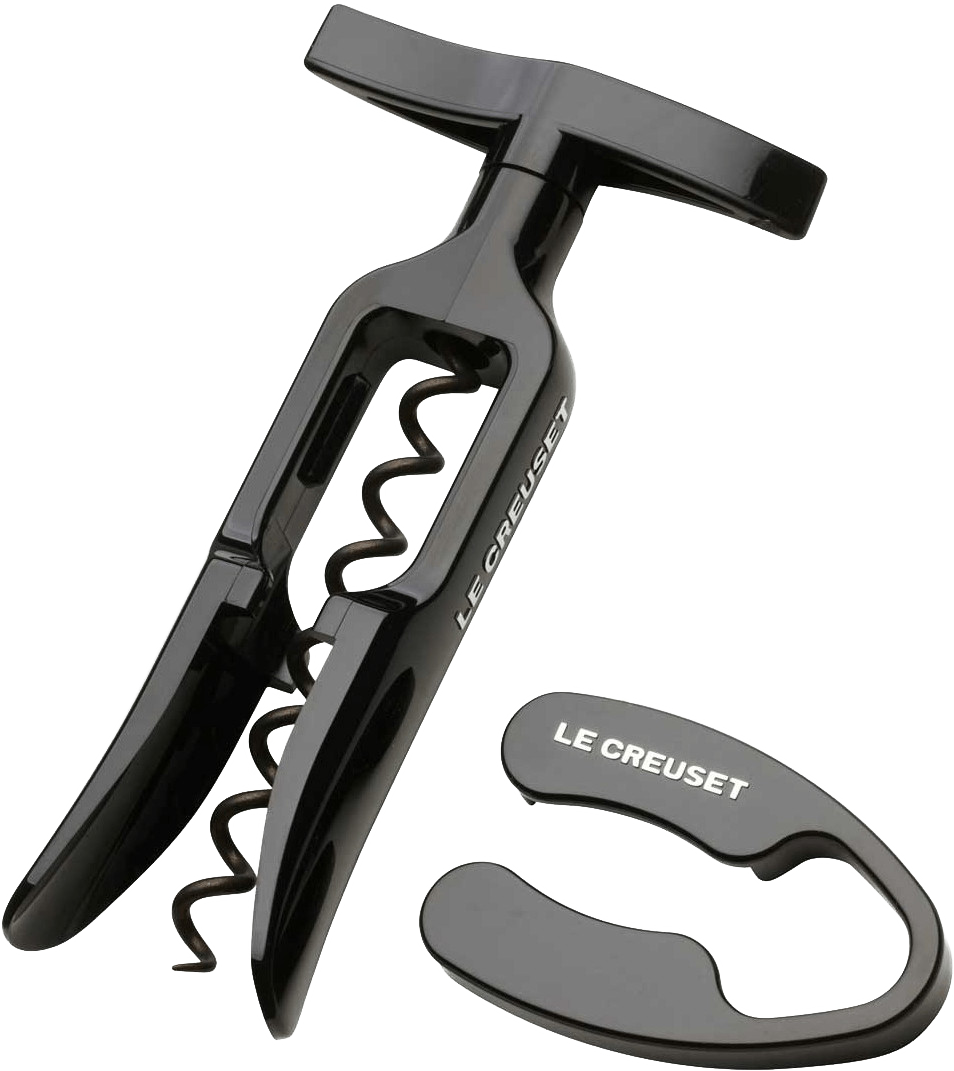
Screwpull Versus a Waiter’s Corkscrew
A Screwpull lever opener is usually easier to operate, while a waiter’s corkscrew is smaller and more portable.
| Feature | Screwpull lever opener | Waiter’s corkscrew |
|---|---|---|
| Ease of use | Generally easier for repeated opening | Requires more hand control |
| Portability | Varies by model | Very portable |
| Storage | Moderate to large | Small |
| Speed | Fast after practice | Fast for experienced users |
| Fragile corks | Can offer a steady pull | Depends heavily on technique |
| Cost | Often higher | Available at many price levels |
Neither design is automatically best for every bottle. A waiter’s corkscrew may be better for travel, while a lever Screwpull may be better for home use.
For very old wines with fragile corks, a two-prong opener may be worth considering. That tool grips the sides of the cork rather than drilling through its center. It is a separate style and requires its own technique.
Safety Limits and Important Exceptions
Use a Screwpull opener only with bottles designed for cork removal. Do not use it to open carbonated wine, beer, or other pressurized bottles.
Sparkling wine bottles contain pressure. Open them with the approved sparkling-wine method: keep the bottle pointed away from people, control the cork with a towel, and turn the bottle rather than pulling the cork upward.
Do not use a wine opener on a bottle with a cracked neck, damaged glass, or visible structural damage. Set that bottle aside.
Keep the worm away from children. The spiral is sharp, and a loose lever can pinch fingers. If the opener slips repeatedly, stop using it rather than adding more force.
Frequently Asked Questions
Is Le Creuset Screwpull the same as a regular corkscrew?
No. Screwpull is a product line that includes several corkscrew designs. Some use traditional rotation, while lever models use mechanical advantage to lift the cork.
Can a Screwpull opener remove synthetic corks?
Usually, yes, if the worm is sharp and properly centered. Synthetic corks can feel tighter than natural corks, so use steady pressure and avoid pulling at an angle.
Can I replace the worm on an older Screwpull opener?
Replacement availability depends on the exact model and production year. Identify the model before ordering a part, and verify compatibility with Le Creuset support or an authorized seller.
Why does my wine opener leave cork dust in the bottle?
The cork may be dry or crumbly, or the worm may be entering at an angle. A damaged cork can shed dust even with proper technique. Strain the wine if needed.
Is a lever Screwpull better than a waiter’s corkscrew?
It is often easier for home use and repeated opening, but it is larger and usually less convenient to carry. The better choice depends on whether you value leverage or portability.
Key Takeaways
- A Le Creuset Screwpull wine opener uses a worm and leverage to remove corks.
- Center the opener and keep it vertical to reduce breakage.
- Choose a lever model for ease, a pocket model for travel, and a traditional model for simple storage.
- Check the exact model before buying replacement parts.
- Do not use a standard corkscrew for pressurized bottles.
- Replace or repair an opener with a bent worm, loose handle, or unstable mechanism.
Conclusion
A Le Creuset wine opener Screwpull is a useful choice when you want controlled cork removal with less pulling effort. The best model depends on your space, travel needs, hand strength, and how often you open wine.
For most home users, a well-maintained lever model offers the easiest operation. For travel, a compact opener makes more sense. Whichever design you choose, proper alignment, slow pressure, and regular cleaning matter more than the finish or appearance.

Hi, I’m Mary, the founder of KitchenClue.com. I’m deeply passionate about everything that makes a kitchen smarter, easier, and more enjoyable. I share hands-on insights and practical expertise on kitchen gear that truly helps in daily cooking. Along with my dedicated research team, we study products carefully, and our writers create honest, well-tested reviews using trusted, authentic sources—so you can choose kitchen tools with total confidence.