5 Best Container for Ground Coffee In 2026
Let’s be real. You spent good money on those coffee beans. You might have even splurged on a fancy bag of single-origin roast or grabbed some premium ground coffee from your local roaster. Then what happens? You dump it in some random jar and wonder why it tastes flat and stale a week later.
Your coffee container isn’t just a vessel. It’s the thing that keeps your coffee fresh, protects it from air and light, and makes sure that rich flavor sticks around. Bad storage can turn excellent coffee into something that tastes like cardboard in days.
This is where the right coffee canister comes in. A good ground coffee storage container does several important jobs. It keeps oxygen out so your coffee doesn’t oxidize. It protects from light so the beans don’t degrade. It keeps moisture away so the coffee doesn’t get damp. And honestly, it should look nice on your counter because you’re going to see it every single day.
I’ve been testing coffee containers for a long time. I’ve filled them up, sealed them, opened them, and measured how well they actually keep coffee fresh. In this roundup, I’m breaking down five solid options that actually work. No fluff. No paid sponsorships. Just honest assessments of what you get and whether it’s worth your money.
The Veken Coffee Canister: The Reliable Workhorse
What You’re Getting
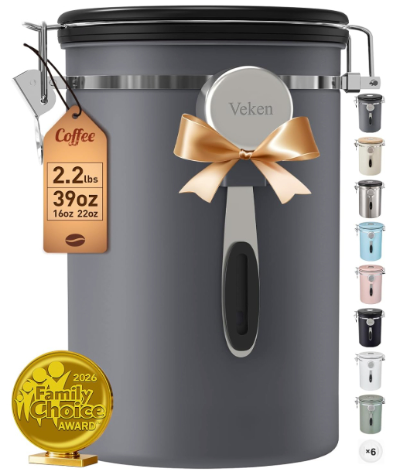
The Veken large stainless steel canister holds 39 ounces, which translates to about 2.2 pounds of ground coffee. That’s a solid amount for most coffee drinkers—roughly two weeks of coffee for an average household.
The body is made of brushed stainless steel. The lid is a simple twist-and-seal design with a rubber gasket that creates an airtight seal. It comes in a gray finish that looks neutral and blends into most kitchen designs.
Best Use Cases
This canister shines if you’re someone who buys coffee regularly and wants something straightforward. It works great for ground coffee, but the manufacturer also mentions it holds beans, sugar, flour, tea, and cereal. If you want one canister that does multiple jobs in your pantry, this is flexible.
It’s also good if you’re new to proper coffee storage. Nothing fancy here—no springs, no fancy lids, no complicated mechanisms. Just fill it, screw the lid on, and done.
Key Features Explained Simply
The airtight seal is the main feature. That rubber gasket is what makes the magic happen. When you twist the lid, the gasket compresses and creates a barrier that keeps air out. Stainless steel resists rust and handles temperature changes without expanding too much.
The size is right in the middle. Not too huge that it takes up half your shelf. Not so tiny that you’re refilling it every three days. For people who buy a standard bag of ground coffee, this is the Goldilocks size.
Real-Life Usage Insight
When you use this canister, you notice right away that the lid takes a bit of force to twist. This isn’t bad. Actually, it’s a sign the seal is working. A lid that twists too easily means air might be getting in and out.
The lid is made of food-grade plastic with a stainless steel ring around it. That makes it lighter than full metal, so it’s less likely to slip from your grip. The canister sits flat on your counter, and the curved shape doesn’t really show fingerprints, which is nice.
One thing to know: you’ll want to hand wash this. The gasket can eventually wear if you throw it in the dishwasher every week. Hand washing takes 30 seconds and helps it last way longer.
Honest Pros and Cons
Pros:
- Simple design means no parts to break
- Holds a good amount of coffee
- Stainless steel looks clean and matches most kitchens
- The seal actually works—coffee stays fresh
- Affordable compared to fancier options
- Works with ground coffee, beans, and other dry goods
Cons:
- The lid can be stiff at first, which some people find annoying
- No way to know how much coffee is left without opening it
- Doesn’t remove excess oxygen like some high-tech containers
- The plastic lid might eventually crack if twisted too hard
Performance Discussion
How does it actually keep coffee fresh? When you seal it properly, this canister blocks most oxygen exchange. Coffee stored in this container stays fresh for about two to three weeks, which is solid for a basic airtight container.
The temperature stability is decent. Stainless steel doesn’t conduct heat super quickly, so your coffee won’t fluctuate temperature wildly just because it’s on a shelf near a window. Light protection is moderate—stainless steel blocks most visible light, but some very bright light might penetrate to the edges.
Ease of Use
Using this is straightforward. Pick it up, twist the lid, scoop out your coffee, twist it back on. That’s it. No buttons to press, no springs to mess with, no complicated lids. The weight is manageable—not so heavy that lifting it feels like a chore, but heavy enough to feel sturdy.
The opening is wide enough that you can fit a coffee scoop inside without struggling. This is important because it means you’re not fumbling around trying to get coffee out.
Value for Money
At its price point, this canister is a straight-up bargain. You’re not paying extra for fancy technology. You’re paying for solid stainless steel and a lid that works. If you want to start storing your coffee properly without spending a lot, this is where you land.
The Oggi Stainless Steel Coffee Canister: The Visual Option
What You’re Getting
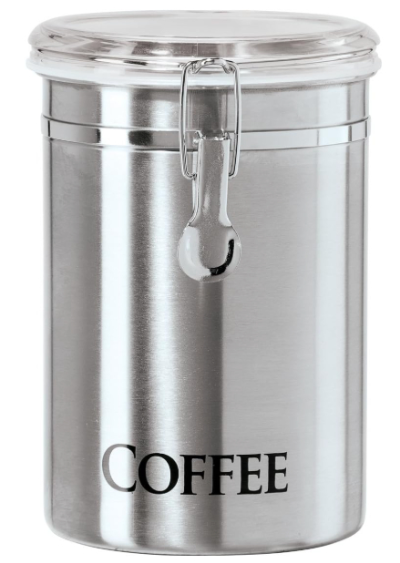
The Oggi comes in at 62 fluid ounces, which is about 40% bigger than the Veken. That’s roughly 3.5 pounds of coffee. The standout feature is the clear top. You can actually see your coffee level without opening the container.
The body is stainless steel with a see-through lid panel. The clamp mechanism is the distinctive part here. Instead of a twist-on lid, it’s a hinged lid with little clamp arms that fold down and lock into place.
Best Use Cases
This is the container for people who like to see what they have. If you’re the type to check your coffee supply and plan your next order, the clear top saves you from popping it open all the time.
It’s also good for aesthetic-minded people. The stainless steel body is sleek, and the clear top shows off your coffee beans or grounds. If your coffee canister is part of your kitchen display, this looks intentional and nice.
For households that go through coffee fast and buy in larger quantities, the bigger size means fewer refills.
Key Features Explained Simply
The clamp lid system is worth understanding. It’s not just for looks. Those clamp arms create a tight seal when you fold them down. The pressure from the clamps compresses a gasket inside, creating an airtight environment.
The clear top is polycarbonate plastic, not glass. This matters because plastic is more forgiving if it drops. It’s also lighter, which means the lid doesn’t feel heavy.
The stainless steel body is food-grade, rust-resistant, and durable.
Real-Life Usage Insight
When you first use this, the clamp system feels satisfying. You actually hear and feel the lid lock into place. It’s different from a twist-on lid, and some people find it more reliable—you know for sure when it’s sealed.
The clear top works well for the first few uses. Then reality sets in a bit. If you buy dark roasted grounds or beans, you can see them fine. But the see-through panel collects dust over time. Not grimy dust from outside—just regular kitchen dust settling on the plastic. It’s easy to wipe off, but you’ll notice it.
The size does make it bulkier on the counter. If you have limited shelf space, this might feel like it takes up too much real estate.
Honest Pros and Cons
Pros:
- See-through top is genuinely useful for checking levels
- Larger capacity means fewer refills
- Clamp system feels solid and creates a strong seal
- Stainless steel finish is attractive
- Good for visible kitchen storage
- Durable construction
Cons:
- Takes up more counter space
- Clear plastic top can collect dust
- Clamp system adds complexity
- Slightly more expensive than basic twist-on options
- The clamp arms can occasionally pinch fingers if you’re not careful
Performance Discussion
This canister keeps coffee fresh for about three weeks. The clamp seal is actually very effective. The pressure those clamp arms create is tight enough to block most oxygen exchange.
Temperature management is good due to the stainless steel body. Light protection is excellent on the sides and bottom, though the clear top obviously lets some light through. If your counter gets direct sunlight, this might be a consideration.
Ease of Use
Using this is easy once you get the clamp system down. Open the clamp arms, lift the lid, scoop your coffee, replace the lid, and clamp it down. Takes maybe 10 seconds longer than a twist-on lid, but not in a bad way.
Cleaning is straightforward. The lid lifts right off since it’s hinged, so you can actually reach down and clean the inside of the canister easily. That’s an advantage over sealed lids that don’t come off.
Value for Money
This one costs more than the Veken, but you get extra capacity and that clear top feature. If you like being able to see your supplies and don’t mind spending a bit more, the extra cost makes sense. The value proposition works if the clear top actually saves you from opening the container constantly.
The AirScape Planetary Design Coffee Canister: The Oxygen-Removing Champion
What You’re Getting
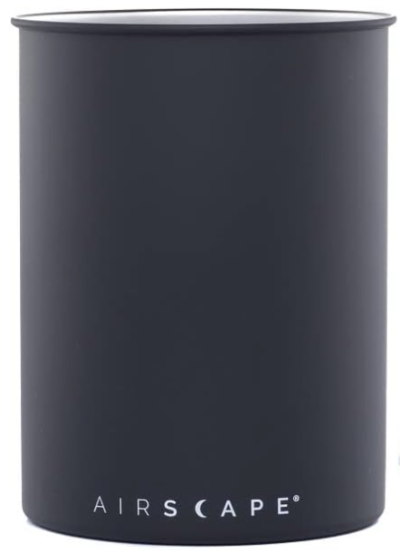
This is different from the previous two. The AirScape has a patent on its inner plunger lid system. The medium size holds about 1 pound of whole beans or ground coffee.
The body is stainless steel in matte black. The lid contains the special mechanism—a plunger that sits inside and physically removes excess air from the container. You fill it, press the lid down, and the plunger pushes air out as it seals.
Best Use Cases
This canister is for the coffee enthusiast who wants maximum freshness. If you buy high-quality coffee and want it to taste its best, the air removal system is a genuine advantage.
It’s also good for people with limited counter space. The medium size is smaller than the Veken and Oggi, so it doesn’t dominate your shelf.
The matte black finish is beautiful, so it works well if your kitchen has a modern or upscale vibe.
Key Features Explained Simply
The air removal system is the whole point. Here’s how it works. The lid has a plunger built in. When you push the lid down onto the coffee, the plunger descends and physically pushes excess air out of the container. The seal happens as you press down, trapping very little oxygen inside.
This is different from just airtight sealing. With a regular airtight container, air is already inside. You seal the lid, but the air stays in there and still degrades your coffee. With the AirScape, that air gets removed.
The patent on this system is legit. You won’t find this feature anywhere else.
Real-Life Usage Insight
The first time you use this, the difference is noticeable. You press the lid down, and you feel the plunger moving. There’s actually some resistance because you’re pushing air out. It’s not a huge effort, but you feel like something is actually happening, which is reassuring.
After the first press, you can press it again on subsequent days. Each press removes a little more air as your coffee settles and oxidizes. Many users report pressing the lid down every morning as part of their coffee routine.
The finish is beautiful, but matte black does show fingerprints if you have dry hands. Nothing major, just something to know.
Honest Pros and Cons
Pros:
- Air removal system genuinely extends freshness
- Compact size fits most spaces
- Beautiful matte black finish
- Stainless steel construction is durable
- The plunger system becomes part of your daily routine
- Patent-backed technology actually works
Cons:
- Smaller capacity than other options
- More expensive than basic canisters
- Requires active maintenance (pressing the plunger)
- The plunger mechanism adds complexity
- Not ideal if you buy very large quantities of coffee
Performance Discussion
This is where the AirScape shines. Coffee stored in this container stays fresh for four to five weeks, significantly longer than standard airtight containers. The air removal gives you that extra window of peak flavor.
The vacuum created by the plunger isn’t a true vacuum like a vacuum-sealed bag, but it’s close enough. The remaining air content is minimal, which means minimal oxidation.
Temperature management is solid. Light protection is excellent with the matte black finish blocking almost all light penetration.
Ease of Use
Using this requires slightly more intentionality than a twist-on lid. You have to press the lid down with enough force to engage the plunger. It’s not difficult, but it’s a process. Once you do it a few times, it becomes automatic.
The lid doesn’t come off easily, which is by design. You don’t want air getting back in. This also means cleaning requires more care. You can’t just remove the lid and wash inside the container. You need to use a bottle brush or carefully clean around the plunger.
Value for Money
This is the most expensive option in this roundup, but the air removal technology justifies the cost if you care about freshness. For coffee lovers who buy expensive beans, spending extra on storage that extends freshness is a smart investment.
The KIVY Vacuum Coffee Canister: The Hybrid Approach
What You’re Getting
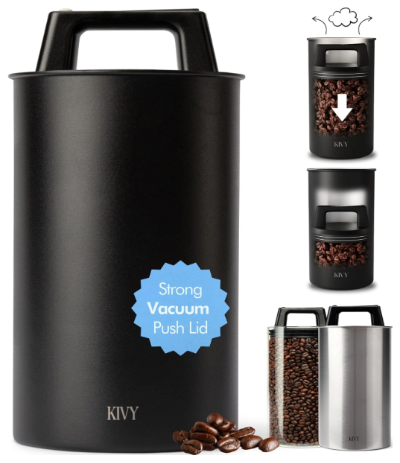
KIVY makes a stainless steel canister with a unique push-lid system. The lid doesn’t twist—you press it down. This motion powers a vacuum mechanism that removes excess air. It’s a middle ground between simple and complex.
The capacity is around 30 ounces, sitting between the small and large options. The finish is stainless steel with a simple, clean design.
Best Use Cases
This works great for people who want air removal without the price tag of the AirScape. You get similar functionality at a lower cost.
It’s also good if you want something simpler than the AirScape but more sophisticated than a basic twist-on lid. The push system is easier than the plunger approach because you’re not squeezing something—you’re just pressing down.
Key Features Explained Simply
The push-lid system powers a small vacuum pump. When you press the lid down, you’re actuating a mechanism that removes air. It’s a clever engineering solution.
The lid has a button you press to activate air removal. After you fill the canister and place the lid on, you press the button, and the mechanism removes excess air. Then the seal locks in.
Stainless steel construction is straightforward and durable.
Real-Life Usage Insight
Using this feels smooth. You fill it, press the lid on, and then press the air removal button. The button gives you feedback—you can feel it engaging. The whole process takes about 10 seconds.
The lid removes a good amount of air. Not quite as much as the plunger in the AirScape, but significantly more than a basic airtight container.
The design is clean, so it doesn’t feel overly mechanical or complicated. It just works.
Honest Pros and Cons
Pros:
- Air removal system is easier than plunger design
- Mid-range pricing is reasonable
- Simple, clean design looks modern
- Stainless steel is durable
- Decent capacity for most households
- Effective at keeping coffee fresh
Cons:
- Not quite as much air removal as AirScape
- The button mechanism could potentially break over time
- Mid-range capacity means more frequent refills than larger canisters
- Slightly less elegant than the AirScape design
Performance Discussion
Coffee stays fresh for about three to four weeks in this canister. It’s better than basic airtight but not quite reaching the five-week mark of the AirScape.
The vacuum effect is real but not extreme. The air removal is effective enough to make a noticeable difference in flavor retention.
Temperature and light protection are solid due to the stainless steel construction.
Ease of Use
This is easy. Fill, press the lid, press the button. The button has a satisfying click. You don’t need a lot of hand strength or precision. If you have any physical limitations, this system is more forgiving than the plunger.
Cleaning is easier than the AirScape because the lid design is simpler. You can wipe it down without worrying about a complex mechanism.
Value for Money
The pricing sits between the simple canisters and the AirScape. If you want air removal technology but not the premium AirScape price, this represents good value. You’re paying for the button mechanism, but not an extreme amount more.
The Ohtomber Coffee Canister: The Feature-Packed Compact
What You’re Getting
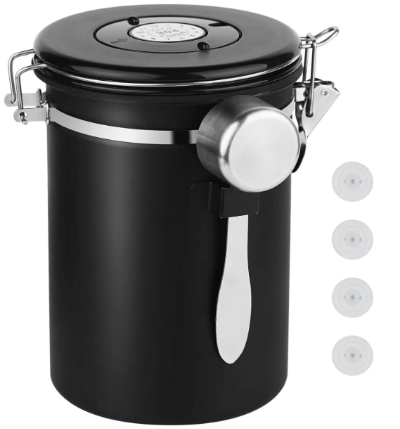
Ohtomber offers a smaller stainless steel canister at 22 ounces with several extras. It includes a date tracker label and a measuring scoop. Both of these are genuinely useful additions.
The stainless steel body has a twist-on lid with a rubber gasket, similar in design to the Veken. The date tracker is a small label you stick on the side where you write the date you opened the coffee.
Best Use Cases
This is great if you’re just starting to pay attention to coffee freshness. The date tracker forces you to think about how old your coffee is. It’s a cheap way to develop good habits.
If you like gadgets and extras, the included measuring scoop is handy. No fumbling to find the right amount of coffee. Just scoop.
It’s also good for smaller households or people who rotate through several different coffees. The 22-ounce size is perfect for trying different beans without committing to a huge amount.
Key Features Explained Simply
The date tracker label is low-tech but effective. You write the date on it when you open the coffee. As time goes on, you can see at a glance how old your coffee is. This simple visual cue helps you remember to use older coffee before opening new bags.
The measuring scoop holds the right amount for a standard cup of coffee. No guessing, no dealing with loose measurement guides. Scoop once, use it.
The twist-on lid is reliable. The rubber gasket creates a proper seal.
Real-Life Usage Insight
People find the date tracker surprisingly motivating. It’s not just a reminder—it’s a small accountability measure. You can see the date staring you in the face, which makes you more likely to use the coffee before it gets too old.
The measuring scoop gets used constantly. Once you have the right size, you don’t want to go back to eyeballing it.
The smaller size means this sits easily in cupboards or on shelves. It’s also light enough that even older people or kids can handle it.
Honest Pros and Cons
Pros:
- Date tracker label is genuinely useful
- Measuring scoop saves time
- Compact size fits anywhere
- Affordable price
- Twist-on lid is proven and reliable
- Good for trying different coffees
Cons:
- Smaller capacity means frequent refills
- Basic airtight only—no air removal
- Date tracker is useful but requires you to actually use it
- Not ideal for large households
- The stainless steel finish isn’t as premium as some options
Performance Discussion
Coffee stays fresh for about two to three weeks. The seal works fine, but without air removal, you’re limited by oxidation. The date tracker actually helps here because it makes you aware of age—you’ll use older coffee before it truly degrades.
Temperature and light protection are solid due to stainless steel.
Ease of Use
Very easy. Scoop, twist, close. The measuring scoop makes the whole process even simpler because you don’t have to think about how much you’re scooping.
Cleaning is simple. Hand wash the lid and gasket, quick rinse, done.
Value for Money
This is affordable and includes extras that add real value. The scoop and date tracker aren’t expensive to include, but they actually improve your experience. For the price, you get a functional container plus useful accessories.
Comparison Insights: How These Canisters Stack Up
Let’s look at the big picture. Each of these containers solves the problem of keeping coffee fresh, but they approach it differently.
Size Breakdown:
- Ohtomber: 22 oz (smallest)
- Veken: 39 oz (medium)
- KIVY: 30 oz (small-medium)
- Oggi: 62 oz (largest)
- AirScape: ~30 oz for medium (designed for quality over quantity)
Freshness Performance:
- AirScape: Best (4-5 weeks)
- Oggi & KIVY: Good (3-4 weeks)
- Veken & Ohtomber: Solid (2-3 weeks)
Price Tier:
- Budget: Ohtomber, Veken
- Mid-Range: KIVY, Oggi
- Premium: AirScape
Best for Beginners: Veken or Ohtomber. Both are simple, affordable, and effective. The Ohtomber edges ahead because the date tracker and scoop make you more aware of freshness.
Best for Aesthetics: AirScape for modern minimalists. Oggi for people who want to see their coffee. Both look intentional on a counter.
Best for Serious Coffee Drinkers: AirScape if budget allows. KIVY if you want air removal at lower cost. Both keep coffee fresh significantly longer.
Best for Large Households: Oggi due to capacity. Veken as a solid secondary option.
Best Value Overall: Veken gives you the most straightforward quality-to-price ratio. You get solid stainless steel and an effective seal for a reasonable cost.
The Coffee Storage Buying Guide
Before you buy any container, think about a few things.
How Much Coffee Do You Buy At Once?
If you buy a standard 12-ounce bag, you need at least a container that holds more than that to avoid cramming it in. Most of the options here handle that fine. If you buy in bulk—five pounds at a time—you need something bigger like the Oggi or you need multiple containers.
How Long Does Your Coffee Usually Last?
If you drink coffee every single day and go through beans fast, a basic airtight container works fine. You’re not storing it long enough for oxidation to be a huge issue. If you’re a casual drinker and a bag lasts weeks, air removal becomes more valuable.
What’s Your Kitchen Style?
This matters more than it sounds. A canister you hate looking at won’t stay on the counter—it’ll end up in a cabinet where you forget about it. If you like stainless steel, the options here all work. If you prefer warm wood tones, none of these will be perfect, but the neutral options work as compromises.
How Much Counter Space Do You Have?
The Oggi is noticeably bulkier. The AirScape and KIVY are compact. The Veken and Ohtomber are mid-range.
Are You Willing To Pay For Air Removal?
This is the big decision point. Air removal technology—either plunger or button—genuinely extends freshness. If fresh coffee matters to you and you buy good beans, the extra cost is worth it. If you’re a casual drinker who just wants basic freshness, save the money and go with a twist-on lid.
Who Should Buy Each of These Containers
Buy the Veken if:
- You’re new to proper coffee storage
- You want straightforward reliability
- You’re on a tight budget
- You like simple design that works
- You drink coffee regularly but aren’t obsessive about it
Buy the Oggi if:
- You like being able to see your supplies
- You buy coffee in quantity
- You want to show off your canister
- You don’t mind spending extra for aesthetics plus function
- You have space for a larger container
Buy the AirScape if:
- You buy high-quality coffee and want it to stay that way
- You’re willing to spend more for technology that works
- You like the matte black aesthetic
- You appreciate engineering and design
- You’re fine with smaller quantities in exchange for better freshness
Buy the KIVY if:
- You want air removal at a lower price point than AirScape
- You like the idea of a push-button system
- You want something between basic and advanced
- You have moderate counter space
- You drink good coffee but aren’t a hardcore enthusiast
Buy the Ohtomber if:
- You’re trying to develop better coffee habits
- You like the included measuring scoop and date tracker
- You try different coffees and don’t need huge capacity
- You want compact size for a smaller household
- You’re budget-conscious but still care about freshness
Common Mistakes People Make With Coffee Storage
Even with a great container, people mess up storage. Here’s what to watch out for.
Leaving the Lid Open Too Long
Every time you open the container, air rushes in and your coffee immediately starts oxidizing again. Scoop what you need, close it right away. Don’t leave it sitting open while you’re making your coffee. That’s adding air exposure you don’t need.
Storing Near Heat or Sunlight
Your coffee container shouldn’t live next to the stove or under a bright window. Heat and light both speed up oxidation. Find a cool, dark shelf in your pantry or a cabinet if you have one.
Not Sealing Properly
With twist-on lids, people sometimes don’t twist hard enough. You should feel a bit of resistance. The lid should be snug. With clamp systems, actually engage the clamps fully. With button systems, make sure the button actually activates.
Ignoring the Date
If you have the Ohtomber with the date label, use it. If you have another container, use a permanent marker to write the date on a piece of tape and stick it somewhere. Know how old your coffee is. This is the easiest way to avoid stale coffee.
Overfilling the Container
Don’t cram coffee in there. Leave a little space at the top. This gives air removal systems room to work and prevents coffee from getting squished.
Storing Coffee in the Fridge or Freezer
This is a common mistake. People think cold keeps coffee fresh longer, but temperature fluctuations when you take the container in and out create condensation. Moisture is the enemy. Room temperature in a dark place is perfect.
Buying Too Much At Once
One reason to get a smaller container like the AirScape or Ohtomber is that you buy smaller quantities more frequently. Fresh coffee that you finish in two weeks is better than coffee that sits for two months. Buying less often doesn’t make sense just to make fewer trips to the coffee shop.
Performance Expectations: Real-World Freshness
Here’s what to actually expect from your container in real life.
Fresh roasted coffee has a two-week window where it’s at peak flavor. It’s drinkable after that, but the magic starts fading. Most coffee reaches diminishing returns after four weeks.
A basic airtight container like the Veken keeps you in that two to three-week sweet spot. Your coffee is fresh during the period when it matters most.
Containers with air removal like the AirScape push that to four to five weeks. This matters if you buy in larger quantities or if you’re the type to try new beans and keep a few varieties around.
The stainless steel construction matters more than the lid mechanism in terms of light and temperature protection. All of these containers protect well from light. Temperature swings are minimal in most homes unless your kitchen gets extreme.
Humidity can be an issue in some climates. If you live somewhere very humid, airtight seals are crucial. All of these containers seal well, so you’re covered.
The Bottom Line: Which Container Should You Choose?
If I had to recommend one container for someone asking me in a coffee shop, I’d say start with the Veken. It’s affordable, reliable, straightforward, and keeps coffee fresh for the period when it matters most. No complexity, no over-engineered lid system, just good storage.
If you love coffee and buy nice beans, the AirScape is worth the splurge. The air removal system is patented for a reason—it works. You’ll notice fresher-tasting coffee, and the beautiful design makes you want to use it.
If you’re between those two, KIVY splits the difference. You get air removal technology without the AirScape’s premium price, and the button system is more intuitive than the plunger.
For visual appeal and large capacity, Oggi is solid. The clear top is legitimately useful, and the clamp system is satisfying to use.
For developing good habits, Ohtomber gets you started with the date label and measuring scoop at a budget price.
None of these containers are bad. They all keep coffee fresher than throwing it in a regular jar. The difference is in features, aesthetics, and how long you can keep coffee at peak flavor.
Your coffee container isn’t the most important part of your coffee experience—your beans, your grind, and your brewing method matter more. But proper storage removes one reason for your coffee to taste bad. It’s the foundation that lets your good beans stay good.
Take your time, think about what matters to you—whether that’s price, aesthetics, size, or freshness performance—and choose the container that fits your life. Then actually use it. Close the lid. Check the seal. Keep your coffee fresh.
That’s the whole game.
Final Verdict
A quality coffee container is one of the cheapest investments you can make in your coffee experience, and it pays dividends every single morning. Whether you go with the budget-friendly Veken, the feature-packed Ohtomber, the stylish Oggi, the innovative KIVY, or the premium AirScape, you’re making a choice to take your coffee storage seriously.
The best container for ground coffee is the one you’ll actually use consistently. If it’s on your counter and sealed properly, it’s doing the job. If it sits in a cabinet and you keep opening it partially sealed, the fanciest mechanism in the world won’t save your coffee.
Pick one, use it right, and enjoy coffee that tastes like it’s supposed to taste. That’s the goal, and any of these containers gets you there.

Hi, I’m Mary, the founder of KitchenClue.com. I’m deeply passionate about everything that makes a kitchen smarter, easier, and more enjoyable. I share hands-on insights and practical expertise on kitchen gear that truly helps in daily cooking. Along with my dedicated research team, we study products carefully, and our writers create honest, well-tested reviews using trusted, authentic sources—so you can choose kitchen tools with total confidence.