5 Best Chef Knife for Under $50 In 2026
You don’t need to spend a fortune to get a knife that performs like a dream in your kitchen. The truth is, there are some seriously good chef knives available for under $50 that can handle everything from slicing tomatoes to breaking down a whole chicken.
After looking at hundreds of options, I’ve narrowed it down to five excellent choices that won’t drain your wallet. These knives prove that quality doesn’t always come with a premium price tag. If you’re tired of struggling with dull blades or just want to upgrade your kitchen without breaking the bank, you’re in the right place.
Let’s dive into what makes these knives worth your money and which one might be the perfect fit for your kitchen.
What Makes a Great Budget Chef Knife?
Before we get into the specific products, let’s talk about what you should actually look for. A good chef knife needs to feel balanced in your hand. It should be sharp enough to glide through ingredients without crushing them. The blade should hold its edge for a reasonable amount of time, and the handle needs to feel comfortable during extended use.
Many people think cheaper knives can’t compete with expensive ones. That’s not entirely true. While a $300 knife might have some advantages, a well-made $40 knife can handle 95% of your kitchen tasks just as well. The key is knowing what features matter and what’s just marketing fluff.
The blade material determines how sharp your knife gets and how long it stays that way. Carbon steel holds an edge beautifully but needs more maintenance. Stainless steel resists rust better but might not get quite as sharp. Many modern knives use a combination of both to give you the best of both worlds.
Handle comfort is often overlooked. You might use your chef knife for 30 minutes straight during meal prep. If the handle digs into your palm or feels slippery when wet, you’ll know it by the end of that first meal. The best handles feel like a natural extension of your hand.
Product Reviews: The Top 5 Best Chef Knives Under $50
1. 8 Inch Japanese Knife with Hand Forged 5 Layers High Carbon Steel
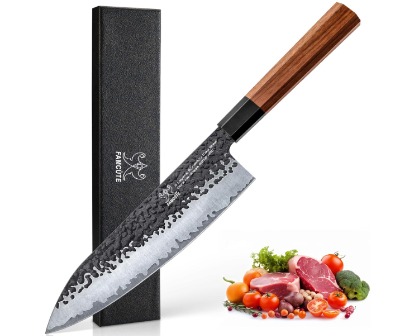
This Japanese-style knife brings traditional craftsmanship to your kitchen without the traditional price tag. The blade uses 5 layers of high carbon 9CR18MOV steel, which is fancy talk for a blade that gets incredibly sharp and stays that way through plenty of cutting sessions.
Product Description
The knife features a classic Japanese design with a rosewood handle that gives it a premium feel. The blade measures 8 inches, making it versatile enough for most kitchen tasks. The hand-forged construction means each knife has slight variations, giving yours a unique character. The Damascus-style pattern on the blade isn’t just for looks—it actually shows the layered construction of the steel.
Best Use Cases
This knife excels at precision work. If you love making sushi, sashimi, or any dish that requires paper-thin slices, this is your tool. It’s also fantastic for vegetables, letting you create those professional-looking julienne cuts with ease. The sharp edge makes it great for slicing meat, though you might want something heavier for breaking down large cuts with bones.
Key Features Explained
The 9CR18MOV steel core is surrounded by additional layers that protect it and create that distinctive wavy pattern. This steel is known for excellent edge retention, meaning you won’t be sharpening it every week. The Rockwell hardness sits around 60-62 HRC, which is quite hard and allows for a very acute edge angle.
The rosewood handle adds elegance and provides a secure grip. Wood handles do require a bit more care than synthetic materials—you don’t want to leave them soaking in water—but they feel warm and natural in your hand. The handle shape follows traditional Japanese design principles, which some people love and others take time to adjust to.
Real-Life Usage Insight
When you first use this knife, the sharpness is immediately noticeable. It falls through ripe tomatoes without any pressure. Onions slice so cleanly you might actually cry less because fewer cell walls get crushed. The balance point sits right at the bolster, making it feel light and nimble.
For daily meal prep, this knife handles everything you throw at it. Chopping herbs becomes almost therapeutic because the knife does all the work. The blade is thin enough to glide through ingredients but substantial enough that it doesn’t feel flimsy. You can rock-chop with confidence, though the flatter blade profile means you might need to adjust your technique if you’re used to German-style knives.
The rosewood handle develops a nice patina over time. It starts to conform to your grip pattern, making it feel more personal. Some users oil their handles occasionally to keep the wood from drying out, which takes maybe two minutes every few months.
Honest Pros and Cons
Pros:
- Extremely sharp right out of the box
- Beautiful Damascus pattern that makes it look expensive
- Holds its edge well through regular use
- Lightweight design reduces hand fatigue
- Rosewood handle feels premium and comfortable
Cons:
- Wood handle requires more maintenance than synthetic options
- The blade can chip if you use it on very hard materials or twist while cutting
- Not ideal for heavy-duty tasks like cutting through bones
- Some people find the handle shape takes getting used to
Performance Discussion
In terms of pure cutting performance, this knife punches way above its weight class. The edge geometry is aggressive, meaning the blade tapers to a very fine point. This makes cutting effortless but also means you need to treat it with respect. Don’t use this knife to pry open cans or cut on glass cutting boards.
The knife maintains its sharpness through weeks of regular use. When it does need sharpening, the hard steel responds well to whetstones. You’ll want to use at least a 1000-grit stone, and the process takes a bit of practice if you’re new to sharpening. The good news is you won’t need to do it often.
Ease of Use
For beginners, there’s a small learning curve. The knife is so sharp that you need to develop a light touch. Press too hard and you’ll cut through things faster than expected. Once you adjust, though, the knife becomes an extension of your hand. The light weight means you can work for longer periods without your hand cramping up.
The handle shape is comfortable for most grip styles. If you use a pinch grip (thumb and forefinger on the blade, other fingers around the handle), it feels very natural. The smooth rosewood doesn’t create any hot spots even during extended use.
Value for Money
At under $50, this knife delivers exceptional value. You’re getting hand-forged construction, high-quality steel, and beautiful aesthetics. Similar knives with Japanese branding can cost three times as much. The only real ongoing cost is occasional handle maintenance and periodic sharpening, both of which are minimal.
This knife should last for many years with proper care. The steel is durable enough to handle daily use, and the construction quality means it won’t fall apart on you. For the price, it’s hard to find anything that competes on the combination of performance and appearance.
2. MOSFiATA 8″ Professional Chef’s Knife with Accessories
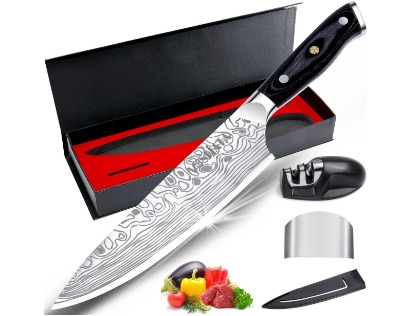
This German-style chef knife comes as a complete package. You get the knife itself, a finger guard to protect your non-knife hand while learning proper technique, and a knife sharpener to maintain the edge. It’s designed for people who want everything they need in one purchase.
Product Description
The MOSFiATA uses German high carbon stainless steel EN1.4116, which balances edge retention with rust resistance. The blade measures 8 inches with a traditional Western profile that has more curve to it than Japanese knives. The handle is made from Micarta, a composite material that’s extremely durable and resistant to water and temperature changes. Everything comes in a gift box, making it presentation-ready if you’re buying for someone else.
Best Use Cases
This knife is built for the all-around home cook. It handles everything from prep work to serving. The included finger guard makes it particularly good for beginners who are still developing their knife skills and want that extra safety margin. The rock-chopping motion that Western knives excel at makes quick work of large piles of vegetables.
The knife sharpener that comes with it means you can maintain the edge at home without investing in expensive sharpening stones. This makes the knife ideal for people who want a low-maintenance setup that doesn’t require learning new skills beyond basic cooking.
Key Features Explained
The EN1.4116 steel is a workhorse material used in many professional kitchens. It contains chromium for stain resistance and carbon for hardness and edge retention. The Rockwell hardness sits around 56-58 HRC, which is a bit softer than the Japanese knife but still plenty hard for home use. This softer steel is actually easier to sharpen, which is why including the sharpener makes sense.
Micarta handles are practically indestructible. This material won’t crack, warp, or absorb odors and bacteria. It stays grippy even when wet, which is a huge safety advantage when you’re working with slippery ingredients. The handle has a subtle texture that provides security without being rough on your hand.
The finger guard is a simple plastic shield that protects your knuckles while you’re learning the proper claw grip. It might feel a bit awkward at first, but it’s a smart training tool that can prevent painful accidents while you’re building muscle memory.
Real-Life Usage Insight
Right out of the box, this knife is sharp and ready to work. The weight distribution feels substantial without being heavy. You can feel the quality when you pick it up—there’s a solidness to it that cheaper knives lack.
The curved blade profile makes rock-chopping effortless. You can keep the tip on the cutting board and use a smooth rocking motion to mince garlic or chop herbs. This technique is hard to master with flatter Japanese blades but feels natural with this knife.
The Micarta handle stays comfortable through long cooking sessions. It doesn’t get slippery when your hands are wet or oily, which happens often during meal prep. The handle shape accommodates different hand sizes well, and the balance point sits right where the blade meets the handle.
The included sharpener is basic but functional. It’s a pull-through style that works quickly. While it won’t give you the same results as proper stone sharpening, it keeps the knife working well between professional sharpenings. A few passes through the sharpener every couple of weeks maintains a serviceable edge.
Honest Pros and Cons
Pros:
- Complete package with finger guard and sharpener included
- Micarta handle is virtually indestructible and stays grippy when wet
- Good weight and balance for Western-style cutting techniques
- Stain-resistant steel requires minimal maintenance
- Comes in a nice gift box
Cons:
- Not quite as sharp out of the box as some competitors
- The included sharpener is basic and won’t give you razor-sharp results
- Heavier than Japanese-style knives, which some people prefer but others find tiring
- The steel is softer, so it needs more frequent sharpening than harder alternatives
Performance Discussion
This knife is reliable and consistent. It doesn’t have the jaw-dropping sharpness of some high-carbon blades, but it makes up for it with durability and ease of maintenance. The edge holds up well to typical kitchen abuse—hitting the occasional bone, cutting through fibrous vegetables, or even accidentally touching the cutting board edge.
The blade thickness provides strength for tougher tasks. You can use this knife to break down a chicken or cut through small bones without worrying about chipping. The flexibility is minimal, which is what you want in a chef knife. It goes where you point it without wandering.
Stain resistance is a real strength. You can cut acidic ingredients like tomatoes or citrus without immediately washing and drying the knife. The steel can handle some moisture without developing rust spots, though you still shouldn’t leave it soaking in the sink.
Ease of Use
For beginners, this might be the best option on the list. The finger guard alone provides peace of mind while you’re learning proper technique. The included sharpener means you don’t need to learn a new skill or invest in additional equipment to keep the knife working well.
The knife’s weight helps it do some of the work for you. You don’t need to apply much downward pressure—just guide the knife and let gravity assist. This makes cutting less tiring and more efficient.
The Western-style rocking motion is intuitive for most people. If you’ve ever used a chef knife before, this will feel familiar. There’s no adjustment period like you might experience with Japanese-style knives.
Value for Money
When you factor in the included accessories, this package offers tremendous value. A decent finger guard costs around $10-15, and a basic sharpener runs another $15-20. Getting everything together for under $50 is a solid deal.
The knife itself is built to last. The Micarta handle won’t deteriorate over time, and the stainless steel blade can handle years of regular use. You might need to have it professionally sharpened once or twice a year if you use it daily, but that’s true of any knife.
For someone just setting up their first kitchen or looking to replace a truly terrible knife, this package gives you everything you need to get started with proper knife work.
3. HENCKELS Forged Accent 8-inch Chef Knife
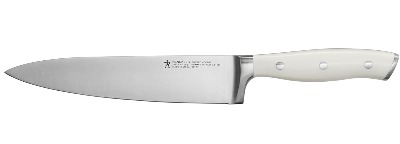
HENCKELS has been making knives for over a century, and that experience shows in this forged chef knife. This is a straightforward, no-nonsense knife that focuses on doing the basics exceptionally well. There are no fancy patterns or extra accessories—just a solid knife built on decades of German engineering expertise.
Product Description
This knife features a single-piece forged construction from German stainless steel. The blade runs 8 inches with a full tang that extends through the white handle. The forging process creates a knife that’s stronger and more balanced than stamped alternatives. The white handle provides a clean, modern look that stands out from the typical black or wood handles.
Best Use Cases
This is your everyday workhorse knife. It handles the full range of kitchen tasks without specializing in any particular area. Morning breakfast prep, afternoon lunch making, evening dinner cooking—this knife can do it all without complaint.
The knife excels in busy kitchens where it needs to move quickly between different ingredients and cutting styles. One minute you’re slicing bread, the next you’re dicing onions, then you’re carving a roast. This knife transitions between these tasks seamlessly.
Key Features Explained
The forged construction means the blade is made from a single piece of steel that’s heated and shaped under extreme pressure. This process aligns the steel’s grain structure, making it stronger and more durable than stamped knives that are simply cut from a sheet of metal.
The full tang design provides excellent balance and durability. The steel runs all the way through the handle, and you can actually see it sandwiched between the handle scales. This construction method is more expensive but creates a knife that can handle serious use without the blade separating from the handle.
German stainless steel is formulated for toughness and edge retention. It’s not the absolute hardest steel available, sitting around 57 HRC, but this moderate hardness makes it versatile and easy to maintain. You can sharpen it easily at home, and it’s forgiving if you accidentally hit something hard.
The white handle is made from a synthetic polymer that’s dishwasher safe, though hand washing is still recommended for longevity. The color shows dirt and stains more readily than darker handles, which actually encourages you to keep it clean.
Real-Life Usage Insight
This knife feels substantial in your hand. There’s a reassuring heft to it that inspires confidence. The balance is neutral, meaning the weight distributes evenly between blade and handle. Some people prefer a blade-heavy knife, others want handle-heavy, but neutral works well for the widest range of people.
The factory edge is good but not spectacular. It’s sharp enough to use immediately, but it really comes alive after you put your own edge on it. HENCKELS designs their knives expecting users to maintain them, so they don’t stress about making the out-of-box edge absolutely perfect.
The blade’s curve is moderate, allowing both rocking cuts and push cuts. You’re not locked into one cutting style. The spine is rounded and comfortable to pinch grip, which is important if you use your index finger and thumb on the blade for control.
After weeks of use, the knife’s consistency is what stands out. It feels the same on day one as it does on day thirty. The edge doesn’t dramatically degrade, the handle doesn’t develop any issues, and the overall performance remains steady.
Honest Pros and Cons
Pros:
- Solid forged construction built to last decades
- Backed by a company with over a century of knife-making experience
- Versatile blade shape handles all common kitchen tasks
- Full tang provides excellent balance and durability
- Easy to sharpen and maintain
Cons:
- Doesn’t come razor-sharp out of the box
- White handle shows stains and discoloration over time
- Lacks the visual flair of Damascus or patterned blades
- No accessories or extra features included
- The design is practical but not exciting
Performance Discussion
This knife prioritizes reliability over flash. It won’t give you the thinnest slices or the most effortless cuts, but it will show up every single day ready to work. The blade holds a working edge well—not for months, but for several weeks of regular use before needing a touch-up.
The steel’s toughness means you can use this knife for harder tasks without worry. Butternut squash, dense root vegetables, even the occasional encounter with a bone won’t harm the blade. It’s not indestructible, but it’s very forgiving.
The knife cuts cleanly without wedging in dense ingredients. The blade geometry is well-executed, with a gradual taper that doesn’t create unnecessary friction. This makes cutting large vegetables like cabbage or pineapple less of a workout.
Ease of Use
This knife is approachable for any skill level. Beginners will appreciate the straightforward design without confusing features to figure out. Experienced cooks will recognize the quality construction and appreciate the lack of gimmicks.
The weight makes the knife stable and predictable. It’s not going to slip or wander on you. When you start a cut, the knife goes exactly where you direct it. This predictability helps you work faster and more confidently.
Maintenance is simple. A few passes on a honing steel before each use keeps the edge aligned. Every month or two, depending on use, you might run it through a sharpener or over a whetstone. The steel responds well to sharpening and doesn’t require special techniques.
Value for Money
For under $50, you’re getting a knife from a respected manufacturer with a proven track record. HENCKELS stands behind their products, and this knife should last for many years with proper care.
The lack of included accessories might seem like a downside, but it also means you’re paying for the knife itself rather than bundled items you might not need. If you already have a sharpener or prefer to use a honing steel, the money goes into knife quality rather than extras.
This knife represents traditional value—paying a fair price for a well-made tool that will serve you reliably. It’s not the most exciting purchase, but it’s one you won’t regret.
4. HOSHANHO Kitchen Knife in Japanese High Carbon Steel
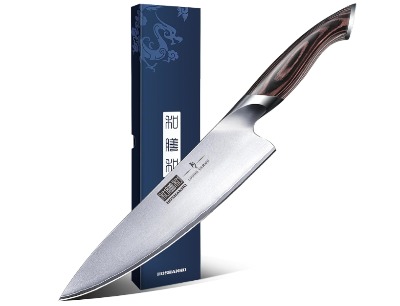
This knife blends Japanese blade-making traditions with practical features for modern kitchens. The high carbon steel blade promises exceptional sharpness, while the ergonomic handle design focuses on comfort during extended use.
Product Description
The HOSHANHO features an 8-inch blade made from Japanese high carbon steel. The blade has a traditional Japanese profile with minimal curve, designed for precise slicing rather than rocking cuts. The handle uses a non-slip material with an ergonomic shape that’s designed to reduce hand fatigue. The finish on the blade has a professional appearance without excessive decoration.
Best Use Cases
This knife shines when you need precision and control. Filleting fish, trimming fat from meat, creating uniform vegetable cuts—these tasks play to its strengths. The blade is thin and sharp enough for delicate work but sturdy enough for general prep.
Home cooks who enjoy Asian cuisine will appreciate how well this knife handles the ingredients and techniques common in those dishes. Slicing proteins paper-thin for hot pot, cutting vegetables into specific shapes for stir-fry, or preparing sushi ingredients all become easier.
Key Features Explained
Japanese high carbon steel is prized for its ability to take and hold an extremely sharp edge. The carbon content makes the steel harder than typical stainless varieties, allowing it to be sharpened to a more acute angle. This same hardness means the blade is slightly more brittle and requires more careful use and maintenance.
The non-slip handle uses a textured synthetic material that provides grip security even when wet or oily. The ergonomic shape curves to fit the natural contours of your hand, with slight indentations for your fingers. This design helps distribute pressure evenly across your palm rather than creating pressure points.
The blade’s flat profile is characteristic of traditional Japanese knives. Instead of rocking the knife, you’re meant to use a push-cut or pull-cut motion, keeping the entire edge in contact with the cutting board. This technique gives you more control over where the cut happens.
Real-Life Usage Insight
The first thing you notice is the sharpness. This knife arrives with an edge that can slice through paper with zero resistance. On ingredients, it feels like the knife is falling through them rather than cutting. Ripe tomatoes, delicate herbs, raw fish—everything gets cut cleanly without crushing.
The handle comfort is immediately apparent. The ergonomic shaping isn’t just marketing—you can feel how it fits your hand. The material has just enough texture to grip securely without feeling rough or aggressive. During longer cooking sessions, your hand stays comfortable without developing hot spots or cramping.
The light weight is noticeable if you’re coming from heavier German-style knives. At first, it might feel too light, almost insubstantial. After you adjust, though, you realize the lightness is a feature. Your hand doesn’t get tired even after chopping vegetables for twenty minutes straight.
The flat blade profile does require some technique adjustment if you’re used to Western knives. You can’t rock-chop effectively with this knife. Instead, you lift the blade completely off the board between cuts or use a slicing motion. Once you adapt to this style, it becomes second nature.
Honest Pros and Cons
Pros:
- Extremely sharp edge right from the start
- Lightweight design reduces hand fatigue during long sessions
- Ergonomic handle is genuinely comfortable
- High carbon steel holds its edge well
- Excellent for precise, controlled cutting
Cons:
- High carbon steel requires more maintenance to prevent rust
- The blade can chip if misused or if you cut very hard materials
- Flat profile requires technique adjustment for some users
- Not ideal for heavy-duty tasks or bones
- Needs regular sharpening to maintain peak performance
Performance Discussion
When properly maintained, this knife delivers professional-level cutting performance. The thin blade glides through ingredients with minimal resistance. The sharp edge bites into whatever you’re cutting without requiring downward pressure. You guide the knife, and it does the work.
Edge retention is good but not exceptional. The high carbon steel holds its sharpness through regular meal prep, but you’ll notice degradation after a week or two of daily use. The good news is the steel sharpens easily, so a quick session with a whetstone brings it back to peak sharpness.
The blade’s thinness is both a strength and a limitation. It excels at slicing tasks where you want minimal food disruption. For harder ingredients or tasks that require blade strength, you need to be more careful. The knife can handle these tasks, but you’re working closer to its limits.
Ease of Use
For beginners, this knife has a steeper learning curve than some alternatives. The sharpness demands respect and a light touch. The flat blade profile requires technique changes if you’re used to rocking motion. The maintenance needs—regular drying, occasional oiling—add steps to your routine.
Once you learn to work with the knife, though, it becomes incredibly efficient. The lightness means you can work faster without tiring. The sharpness means you need less effort for each cut. The precision gives you better control over your results.
The ergonomic handle helps flatten the learning curve. Even if you’re still developing your technique, the comfortable grip makes the knife easier to control. You’re less likely to develop bad habits trying to compensate for an uncomfortable handle.
Value for Money
At under $50, this knife offers excellent value for people willing to invest time in maintenance and technique development. You’re getting professional-grade sharpness and performance at a fraction of the usual cost.
The ongoing maintenance requirements are the main consideration. You’ll need to hand wash and dry the knife immediately after use to prevent rust. Occasional oiling helps protect the blade. These tasks take just a minute but need to become habit.
For someone interested in Japanese knives but not ready to spend hundreds of dollars, this is a great entry point. It has enough of the traditional characteristics to teach you what Japanese knives are about while remaining affordable enough that you won’t panic over normal wear and tear.
5. imarku Japanese Chef Knife with Gift Box
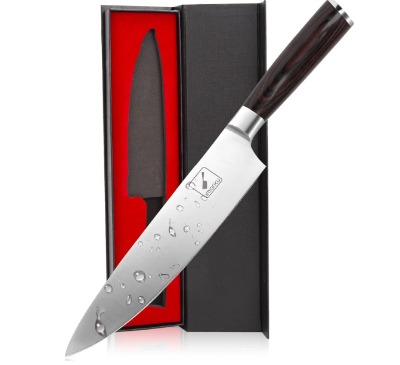
The imarku positions itself as a premium gift option while delivering solid performance for everyday use. The knife comes in attractive packaging with a gyuto-style blade that offers versatility across different cutting tasks.
Product Description
This 8-inch chef knife uses high carbon steel with a gyuto (Japanese chef knife) profile. The blade features a subtle pattern that adds visual interest without being overly flashy. The handle design is simple and functional, and everything comes in a gift box that’s presentation-ready. The knife is marketed toward both home cooks and as a gift for cooking enthusiasts.
Best Use Cases
This knife handles the full spectrum of kitchen tasks. The gyuto profile is Japan’s answer to the Western chef knife, designed to be an all-purpose tool. Morning eggs, afternoon vegetables, evening proteins—this knife transitions between them smoothly.
The gift box packaging makes this particularly suitable for presents. If you’re shopping for a birthday, holiday, or housewarming gift for someone who cooks, this package looks thoughtful and substantial. The knife inside is good enough that the recipient will actually use it rather than letting it sit in a drawer.
Key Features Explained
High carbon steel provides the blade material, offering a balance between edge sharpness and maintenance requirements. The steel is hard enough to hold a keen edge but not so hard that it becomes extremely brittle or impossible to sharpen at home.
The gyuto profile combines elements of Western and Japanese knife design. It has more belly (curve) than a traditional Japanese knife but less than a German chef knife. This middle ground allows both rocking cuts and the straight up-and-down cutting motion that Japanese knives excel at.
The blade pattern isn’t true Damascus but rather an etched or printed design. This is common at this price point and doesn’t affect performance, but it’s worth knowing what you’re getting. The pattern does make the knife look more expensive than it is, which is part of the appeal as a gift.
Real-Life Usage Insight
Out of the box, the knife is quite sharp and ready to use. The edge is refined enough for immediate meal prep without requiring any work on your part. The sharpness falls somewhere in the middle of the pack—better than the HENCKELS but not quite at the level of the dedicated Japanese knives.
The handle fits most hands comfortably. It’s not particularly ergonomic or specially shaped, but the simple design means it doesn’t create any uncomfortable pressure points. The material provides adequate grip even when wet, though it’s not as secure as the Micarta or textured options.
The knife’s weight and balance feel well-considered. It’s light enough to avoid hand fatigue but has enough substance that it feels stable and controlled. The balance point sits slightly forward of the handle, giving the blade a bit more presence during cuts.
The versatility of the gyuto profile becomes apparent as you use it for different tasks. You can rock-chop herbs using the curved section near the tip, then switch to straight slicing for proteins using the flatter middle section of the blade. This adaptability means you reach for this knife more often than more specialized options.
Honest Pros and Cons
Pros:
- Versatile gyuto profile handles many cutting styles
- Comes in nice gift packaging with presentation quality
- Good balance between sharpness and durability
- Pleasant aesthetics without being overly flashy
- Comfortable for most hand sizes and grip styles
Cons:
- The blade pattern is decorative rather than functional Damascus
- Not quite as sharp as dedicated Japanese knives
- Handle is functional but not particularly special
- Some quality control variations between individual knives
- Marketing emphasizes gift aspect over performance details
Performance Discussion
This knife delivers reliable, consistent performance across a wide range of tasks. It’s not the absolute best at any single thing, but it’s good at everything. That versatility has real value in a home kitchen where you’re constantly switching between different ingredients and techniques.
The edge holds up well through normal use. After a week of daily cooking, you’ll notice some degradation but nothing dramatic. A quick honing brings back most of the sharpness, and the knife responds well when you do give it a proper sharpening.
The blade is thick enough to handle tougher ingredients without flexing or bending but thin enough to slice cleanly through delicate items. This middle ground makes it genuinely practical for everyday cooking rather than being optimized for specific tasks.
Ease of Use
This is an approachable knife for any skill level. The design doesn’t have any unusual features or quirks to learn. You can pick it up and start cooking immediately, regardless of your experience level or what kind of knives you’ve used before.
The gyuto profile accommodates different cutting techniques, so you don’t need to change your habits to use this knife effectively. If you prefer rocking motion, the belly supports that. If you like push-cutting, the blade works for that too.
Maintenance requirements are moderate. The high carbon steel needs basic care—wash and dry after use, don’t leave it sitting in water—but it’s not as demanding as some pure carbon steel blades. Most people can integrate the care routine into their existing dishwashing habits without much trouble.
Value for Money
The value calculation here depends on how you plan to use it. As a gift, the presentation adds value beyond just the knife itself. The recipient gets something that looks thoughtful and substantial, and the knife inside is good enough to become a regular tool in their kitchen.
For personal use, you’re paying a small premium for the packaging and presentation. The knife itself would probably cost $5-10 less without the gift box. If those elements don’t matter to you, other options might offer slightly better pure performance value.
That said, the knife quality is solid for the price point. You’re getting a functional, attractive tool that will serve well for years. The versatility means it can handle most of your cutting needs, potentially reducing the number of knives you need to own.
Comparison Insights: How These Knives Stack Up
Now that we’ve looked at each knife individually, let’s talk about how they compare to each other. Each one has different strengths, and the “best” choice depends on what matters most to you.
Sharpness Out of the Box
The hand-forged Japanese knife leads the pack here. It arrives with an edge that’s almost scary sharp. The HOSHANHO comes in second, also featuring impressive initial sharpness. The imarku and MOSFiATA sit in the middle range—sharp enough to use but not spectacular. The HENCKELS is the most modest out of box, though it improves significantly after you sharpen it yourself.
Ease of Maintenance
The MOSFiATA wins for low-maintenance users. The stainless steel blade resists rust, the Micarta handle is indestructible, and the included sharpener handles basic edge maintenance. The HENCKELS comes in second—straightforward stainless steel that’s forgiving and easy to care for. The Japanese knives all require more attention, with immediate drying after use and occasional handle care for the rosewood model.
Durability and Toughness
The HENCKELS forged construction takes the crown for pure toughness. It can handle serious use and occasional abuse without complaining. The MOSFiATA is a close second, with its robust build and forgiving steel. The Japanese knives are more delicate—they perform beautifully but need more careful handling to avoid chips or damage.
Precision and Control
The hand-forged Japanese knife and the HOSHANHO excel here. Their thin blades and sharp edges give you surgeon-like precision for detailed work. The imarku’s gyuto profile offers good control with more versatility. The Western-style MOSFiATA and HENCKELS prioritize stability over precision but still provide adequate control for most tasks.
Best for Beginners
The MOSFiATA package is hard to beat for someone just learning. The finger guard, included sharpener, and forgiving blade make it the most beginner-friendly option. The HENCKELS comes in second—no learning curve, just a straightforward knife that works. The Japanese options require more technique and care, making them better second knives once you’ve developed some skills.
Best Overall Value
This depends on what you value. For pure cutting performance per dollar, the hand-forged Japanese knife wins. For complete package value including accessories, the MOSFiATA leads. For long-term durability and longevity, the HENCKELS offers the best investment. The HOSHANHO and imarku sit in the middle, offering good performance at fair prices.
Buying Guide: What to Consider Before Purchasing
Let’s talk about the factors that should influence your decision. Not all of these knives will fit your needs equally well, and understanding your priorities helps narrow down the choice.
Your Skill Level
Be honest about where you are in your cooking journey. If you’re just learning knife skills, a more forgiving knife with safety features makes sense. The finger guard included with the MOSFiATA isn’t just a gimmick—it prevents real injuries while you’re building muscle memory. A knife that’s easier to sharpen matters more than one that holds its edge forever if you’re still learning how to sharpen.
Experienced cooks can handle the quirks and maintenance needs of higher-performance knives. You already know how to hold a knife properly, so you don’t need training wheels. You probably have sharpening equipment already, so included sharpeners don’t add much value. You might prioritize cutting performance and edge retention over ease of use.
Types of Food You Cook
Think about what ends up on your cutting board most often. If you cook a lot of Asian cuisine, a Japanese-style knife handles those ingredients and techniques better. Lots of vegetables and delicate proteins favor thinner, sharper blades. Heavy-duty tasks like breaking down whole chickens or cutting through dense root vegetables need a more robust knife.
If you cook everything and switch between cuisines regularly, versatility matters more than specialized performance. The gyuto profile of the imarku or the all-purpose design of the HENCKELS might serve you better than a knife that excels at one thing.
Maintenance Willingness
Be realistic about how much time and effort you’ll put into knife care. Some people enjoy the ritual of maintaining their tools. They don’t mind hand-washing, drying, and occasionally oiling their knives. For these people, high-carbon steel blades are perfectly fine.
Others want tools that work with minimal fuss. If washing dishes is already your least favorite kitchen task, adding extra steps for knife care might mean the knife doesn’t get used. Stainless steel blades and low-maintenance handles make more sense for this group.
Handle Comfort
If possible, think about how you hold a knife. Do you use a pinch grip with your thumb and forefinger on the blade? A handle grip with your whole hand on the handle? Different handle shapes favor different grips. Since you can’t physically test these knives before buying, look for handles that accommodate multiple grip styles.
Hand size matters too. Smaller hands might find large, thick handles uncomfortable. Larger hands might feel cramped by slim handles. Most of these knives use moderate handle sizes that work for average hands, but it’s worth considering if you’re at either extreme.
Kitchen Environment
Your kitchen setup influences what knife works best. If you have limited counter space and do prep work in batches, a lighter knife reduces fatigue. If you have a spacious prep area and work continuously, weight distribution and balance become more important.
Your cutting board material matters too. Hard surfaces like glass or marble will quickly damage any knife edge but are particularly rough on harder, more brittle blades. Wood or plastic cutting boards are essential for keeping your knife in good condition.
Who Should Buy These Products?
Let’s get specific about which knife makes sense for different types of buyers.
The Hand-Forged Japanese Knife Is Perfect For:
Home cooks who want to elevate their knife skills and are willing to learn proper maintenance. People who appreciate craftsmanship and aesthetics in their tools. Cooks who focus on precision work—sushi, sashimi, fine vegetable cuts—where extreme sharpness matters. Anyone who already owns basic knives and wants to add something special to their collection.
This knife suits people who enjoy the process of cooking as much as the results. If you’re the type who finds meditation in prep work and takes pride in perfectly uniform cuts, you’ll appreciate what this knife offers.
The MOSFiATA Is Perfect For:
First-time knife buyers who need everything to get started. Students setting up their first kitchen. Anyone nervous about knife safety who would benefit from the finger guard. Busy cooks who want good performance without fussy maintenance. Gift-givers shopping for someone whose skill level or preferences they’re unsure about.
This package works well for practical people who value functionality over aesthetics. If you want a knife that works well and doesn’t require much thought or care, this is your match.
The HENCKELS Is Perfect For:
Traditional cooks who value proven quality over trendy features. People building a knife collection that will last for decades. Anyone who’s had bad experiences with cheap knives and wants something reliable. Cooks who prefer Western cutting techniques and the rocking motion.
This knife appeals to people who appreciate heritage and expertise. If you like knowing that you’re using tools made by people who’ve been perfecting their craft for generations, the HENCKELS story matters.
The HOSHANHO Is Perfect For:
Cooks interested in Japanese knife styles but not ready for the full commitment of extremely high-maintenance blades. People who do a lot of detailed prep work. Home cooks who enjoy Asian cuisine and want a knife that handles those ingredients well. Anyone who values comfort and ergonomics in their tools.
This knife suits people who cook frequently enough that comfort matters. If you’re spending thirty minutes or more on prep work several times a week, the ergonomic handle design becomes genuinely valuable.
The imarku Is Perfect For:
Gift-givers looking for something that looks more expensive than it is. Home cooks who want one knife that handles everything reasonably well. People who appreciate Japanese knife aesthetics but need Western versatility. Buyers who want options and flexibility in their cutting style.
This knife works for people who don’t want to think too hard about technique or specialization. It adapts to however you naturally hold and use a knife, making it a low-stress option.
Common Mistakes to Avoid
Let’s talk about the errors people make when buying and using budget chef knives. Avoiding these mistakes will help you get better results and longer life from whichever knife you choose.
Mistake 1: Using the Wrong Cutting Board
Glass, marble, granite, and ceramic cutting boards look beautiful but destroy knife edges. Every time your blade hits these hard surfaces, it damages the edge. Even the toughest knife will dull quickly on glass. Stick to wood, bamboo, or plastic cutting boards. Your knife will stay sharper much longer, and you’ll spend less time sharpening.
Mistake 2: Putting Knives in the Dishwasher
Even knives marketed as “dishwasher safe” last longer with hand washing. The harsh detergents and high heat damage handles and dull edges. Water and other utensils bang against the blade during the wash cycle, creating tiny chips and dings. Hand washing takes thirty seconds and preserves your knife’s condition.
Mistake 3: Storing Knives Loosely in a Drawer
Tossing knives into a drawer with other utensils is dangerous and damaging. The blades bang against metal objects, dulling edges and creating chips. You risk cutting yourself when reaching into the drawer. Use a knife block, magnetic strip, or blade guards. Your knives stay sharper, and your fingers stay safer.
Mistake 4: Using Knives for Non-Cutting Tasks
Your chef knife is not a can opener, screwdriver, or prying tool. Using the knife to open packages, scrape food off cutting boards, or pry things apart damages the blade and handle. These actions can bend the tip, chip the edge, or even break the handle. Use the right tool for each job.
Mistake 5: Ignoring Sharpening Until the Knife Is Completely Dull
Waiting until your knife can’t cut a tomato means you’re working with a dangerous tool for weeks or months. Dull knives require more pressure, which makes them more likely to slip and cut you. Sharpen or have your knife professionally sharpened regularly. The knife works better, and you work safer.
Mistake 6: Expecting Perfect Performance Forever Without Maintenance
No knife, regardless of price, maintains its factory edge forever without care. Even the best steel dulls with use. Plan on honing your knife regularly and sharpening it periodically. This is normal tool maintenance, not a sign of poor quality.
Mistake 7: Buying Based Only on Appearance
A beautiful Damascus pattern or elegant handle doesn’t guarantee good performance. Some decorative elements are just etched or printed designs that don’t affect function. Focus on blade material, construction quality, and reviews from actual users before getting swayed by aesthetics.
Mistake 8: Not Considering Your Actual Cooking Habits
Don’t buy a knife based on cooking shows or aspirational thinking. If you rarely cook, an easy-maintenance knife makes more sense than a high-performance blade requiring constant care. If you cook simple meals, you don’t need specialty knife features. Match the knife to your real kitchen life, not your imagined one.
Making Your Final Decision
After all this information, how do you actually choose? Here’s a practical framework for making your decision.
Start by eliminating any knives that don’t fit your must-have requirements. If you know you won’t maintain a high-carbon blade properly, remove those from consideration. If you need something dishwasher-safe despite the recommendations against it, focus on the most forgiving stainless options.
Next, prioritize what matters most to you from this list:
- Maximum sharpness and edge retention
- Low maintenance requirements
- Durability and toughness
- Precision and control
- Versatility across tasks
- Included accessories
- Visual appeal and aesthetics
Rank your top three priorities. Then look at which knife excels in those specific areas. The knife that matches your top priorities is probably your best choice, even if it’s not the highest-rated in other categories.
Consider your budget within the under-$50 range. All these knives fall within that limit, but some leave more room for other purchases. If you need cutting boards, storage solutions, or sharpening tools, a less expensive knife plus accessories might serve you better than the most expensive knife alone.
Think about the learning curve you’re willing to accept. Some knives reward you immediately with minimal adjustment. Others require technique changes or maintenance routines to perform their best. Be honest about whether you’ll actually put in that effort or if you need something that works well with zero learning.
Final Verdict: The Best Chef Knife Under $50
After examining all five knives, here’s the bottom line for each.
For Cutting Performance: The 8-inch hand-forged Japanese knife delivers the best pure cutting experience. The sharpness, edge retention, and precision are exceptional for the price. If you’re willing to maintain it properly and learn to work with high-carbon steel, this knife offers the most impressive performance.
For Beginners: The MOSFiATA package provides everything you need to start developing knife skills safely. The finger guard prevents injuries while you learn proper technique. The included sharpener means you can maintain the edge without buying extra equipment. The forgiving blade handles mistakes without permanent damage.
For Long-Term Investment: The HENCKELS forged chef knife will outlast everything else on this list. The construction quality, steel selection, and manufacturer reputation mean this knife could serve you for twenty years or more. If you want to buy once and not think about replacement, this is your answer.
For Versatility: The imarku gyuto-style knife handles the widest range of tasks and cutting styles. It adapts to however you naturally work rather than requiring you to change your technique. For a one-knife kitchen, this offers the most flexibility.
For Specialized Precision Work: The HOSHANHO excels when you need detailed, exact cuts. The ergonomic handle and sharp blade give you maximum control. If you cook a lot of Asian cuisine or do prep work that requires uniformity and precision, this knife performs best.
The truth is, you can’t really go wrong with any of these options. They all offer legitimate value and will serve you far better than the cheap knives many people use daily. The differences between them matter, but they’re all competent tools that can handle your cooking needs.
Your best choice depends on matching the knife’s strengths to your specific situation. A beginner cook will get more value from the MOSFiATA package than from the sharpest Japanese blade. An experienced cook focused on Asian cuisine will appreciate the HOSHANHO more than the all-purpose HENCKELS.
Think about where you are now and where you want to go with your cooking. Pick the knife that fits your current skill level but has room to grow with you. Any knife you choose from this list will be a significant upgrade if you’re currently using whatever came with your knife block or cost $10 at a big box store.
The best chef knife for under $50 is the one you’ll actually use, maintain properly, and enjoy working with. These five options all meet those criteria in different ways. Read back through the sections on the knives that interest you most, think about your priorities, and trust your judgment. You now have all the information you need to make a confident decision.

Hi, I’m Mary, the founder of KitchenClue.com. I’m deeply passionate about everything that makes a kitchen smarter, easier, and more enjoyable. I share hands-on insights and practical expertise on kitchen gear that truly helps in daily cooking. Along with my dedicated research team, we study products carefully, and our writers create honest, well-tested reviews using trusted, authentic sources—so you can choose kitchen tools with total confidence.