5 Best 8 Inch Chef Knife In 2026
If you spend any real time in the kitchen, you already know this truth: a good chef knife changes everything.
It is not just a tool. It is the one piece of kitchen equipment you reach for every single day. You use it to slice onions, break down chicken, smash garlic, chop herbs, and cube squash. A bad knife makes all of that feel like work. A great knife makes it feel effortless.
The best 8 inch chef knife sits right in the sweet spot. It is long enough to handle big cuts but short enough to stay in control during detailed prep work. That is why the 8 inch size is the most popular length for both home cooks and professional chefs worldwide.
But here is the problem: there are hundreds of options out there, and most of them look the same online. Bold marketing claims, shiny product photos, and confusing technical terms make it really hard to know what you are actually getting.
That is exactly why this roundup exists.
We dug into five of the most popular 8 inch chef knives available right now. We looked at blade materials, handle comfort, edge sharpness out of the box, durability over time, and overall value for money. Every pick here has been selected based on real performance — not just brand reputation or flashy packaging.
So grab a coffee and let’s get into it.
A Quick Note Before You Start Reading
This article covers knives for all kinds of home cooks — from complete beginners who just need something reliable to intermediate cooks who want something with a little more finesse. You will find budget picks, mid-range options, and a few premium choices in the mix.
The goal is simple: help you find the right knife for your kitchen, your cooking style, and your budget. No fluff, no fake hype. Just honest, useful information.
The 5 Best 8 Inch Chef Knives — At a Glance
Before we go deep on each knife, here is a quick snapshot:
| Knife | Best For | Price Range |
|---|---|---|
| Victorinox Fibrox Pro | Best overall beginner knife | Budget |
| HOSHANHO Japanese Steel | Best for precision cutting | Mid-range |
| imarku Gyuto | Best gift option | Mid-range |
| Mercer Culinary Millennia | Best for culinary students | Budget |
| PAUDIN Chef Knife | Best all-rounder with gift packaging | Budget-Mid |
Now let’s get into the full reviews.
1. Victorinox Fibrox Pro Chef’s Knife, 8 Inch

What Is This Knife?
The Victorinox Fibrox Pro is one of the most recommended knives in cooking circles, and it has been for many years. It comes from Victorinox, a Swiss company known for making reliable, practical tools — yes, the same people behind the iconic Swiss Army Knife.
This knife does not try to be fancy. It does not have a Damascus pattern or a rosewood handle. But it does deliver consistent, professional-grade performance at a price that does not hurt your wallet. That is exactly why so many cooking schools, test kitchens, and working home cooks swear by it.
The blade is made from high carbon stainless steel. The handle is a black fibrox material — a textured, non-slip grip that stays secure even when your hands are wet or greasy. The whole knife is also dishwasher safe, which is a rare and genuinely useful feature at this price point.
Key Features
High Carbon Stainless Steel Blade The blade is stamped (not forged), which keeps production costs low. But Victorinox engineers the steel well. The edge holds up better than most stamped blades in this price range. It comes sharp out of the box and stays sharp with regular honing.
Non-Slip Fibrox Handle The textured fibrox handle is one of the best grips in the budget knife world. It stays secure in wet hands, which is critical for safety. The handle is also ergonomically shaped so it sits comfortably in a pinch grip — the grip that professional chefs recommend for best control.
Dishwasher Safe Most quality chef knives should not go in the dishwasher. The Victorinox Fibrox is one of the exceptions. The steel and handle material can handle it. That said, hand washing still extends the life of any blade.
Swiss Quality Control Every Victorinox blade goes through rigorous testing. The brand has a reputation for consistency, so you know what you are getting every time.
Best Use Cases
This knife is a great match for:
- Home cooks who want a reliable daily driver without spending a lot
- Beginners who are just learning knife skills
- Households that need a durable, low-maintenance knife
- Cooks who are hard on their tools and do not want to baby an expensive blade
Real-Life Usage Insight
In a busy home kitchen, this knife punches above its weight. It slices through tomatoes cleanly, handles chicken with ease, and gets through sweet potatoes without too much effort. It is not the prettiest knife on the counter, but it works — and it keeps working.
For anyone who has struggled with cheap knives that go dull after two uses, the Victorinox feels like a revelation. The edge is consistently sharp, the balance is decent, and the handle does not slip even when hands are slick from cutting raw meat or citrus.
Performance
Out of the box, the edge is sharp and ready to use. The blade geometry is well-designed for rocking cuts and push cuts. It is not as thin as a Japanese-style blade, so very delicate slicing requires a bit more attention. But for everyday kitchen tasks, the performance is hard to beat at this price.
The blade holds its edge reasonably well. With regular honing (using a honing steel before each use), it stays sharp for a long time between sharpenings.
Ease of Use
The Fibrox Pro is one of the easiest chef knives to use. The handle fits most hand sizes, the weight is balanced toward the handle (making it feel lighter during long prep sessions), and the grip is comfortable even after extended use.
Beginners will especially appreciate how forgiving this knife is. It does not require a learning curve to hold properly.
Value for Money
Outstanding. The Victorinox Fibrox Pro consistently ranks as one of the best knife values you can find. It competes with knives that cost two or three times as much. For anyone building their first real knife collection, this is the place to start.
Pros
- Exceptionally sharp out of the box
- Non-slip handle stays secure in wet conditions
- Great edge retention for a stamped blade
- Dishwasher safe — rare and practical
- Swiss-made quality control
- Very affordable
Cons
- Not as thin as Japanese blades, so not ideal for ultra-precise cuts
- Plain, utilitarian look — no aesthetic appeal
- Stamped blade (not forged) — slightly less durable long term
- Handle material may not appeal to those who prefer wood or resin
2. HOSHANHO Kitchen Knife in Japanese High Carbon Steel, 8 Inch

What Is This Knife?
HOSHANHO is a newer brand on the scene, but it has made a strong impression with its Japanese-style chef knives. The 8 inch model is built with Japanese high carbon steel and designed for cooks who want precision, sharpness, and a knife that performs at a high level without breaking the bank.
This is a Japanese-style gyuto (a western-influenced Japanese chef knife), which means it has a thinner blade profile and a sharper edge angle than most western-style chef knives. The result is a knife that glides through food rather than pushing through it.
The handle is ergonomically shaped with a non-slip surface, giving it a sturdy grip for different hand sizes. The full tang construction (where the blade metal extends all the way through the handle) adds balance and durability.
Key Features
Japanese High Carbon Steel Blade Japanese high carbon steel is known for taking a very sharp edge and holding it well. It is harder than most western stainless steels, which allows for a thinner grind and a more acute cutting angle. The tradeoff is that it can be slightly more brittle — so it is not the right tool for hacking through hard bones.
Ultra Sharp Edge HOSHANHO sharpens this knife to a very fine edge. Right out of the box, it is noticeably sharper than most knives in this price range. Paper-thin vegetable slices, precise herb chiffonade, and clean protein cuts all become easier.
Ergonomic Non-Slip Handle The handle is contoured for comfort and made from a material that resists slipping in wet or greasy hands. It fits most hand sizes naturally and encourages a proper pinch grip.
Full Tang Construction The blade runs all the way through the handle. This improves balance and makes the knife more durable over the long term compared to partial tang designs.
Professional Look and Feel This knife looks and feels like a professional kitchen tool. The blade has a clean, polished look, and the overall fit and finish are impressive for the price.
Best Use Cases
This knife is ideal for:
- Cooks who want a sharper, thinner blade for precision work
- Anyone who loves Japanese-style cooking or techniques
- Home cooks ready to level up from a basic beginner knife
- Meal preppers who do a lot of vegetable work
- Anyone who does a lot of boneless protein prep
Real-Life Usage Insight
The sharpness of this knife is the first thing you notice. It sails through a ripe tomato without any pressure at all. Thin-sliced cucumbers, precision-cut herbs, and julienned carrots all come out clean and even.
On proteins, the thin blade is a real advantage for slicing chicken breasts thin or cutting fish fillets. It also excels at paper-thin beef slices for stir-fries.
Where it asks for a little more care is on hard, dense items like winter squash or frozen foods — the thinner, harder blade can chip if forced through very tough material. Use a thicker western blade for those tasks.
Performance
The performance level here is genuinely impressive. The edge stays sharp through extended use, and the thin grind reduces the effort needed for most cuts. It is one of the sharpest knives you can buy at this price point.
The balance point sits slightly forward (toward the blade), which some cooks prefer for rocking cuts and others find tiring in longer sessions. It is worth trying both a pinch grip and a handle grip to see what works for you.
Ease of Use
This knife has a small learning curve — not because it is hard to use, but because a sharper, thinner blade rewards proper technique. Keep your angles consistent, use a soft cutting board (wood or plastic), and do not use it to cut hard frozen items. Once you learn those basics, it is one of the most enjoyable knives to cook with.
Value for Money
Very good. You are getting Japanese-quality sharpness and construction at a mid-range price. Cooks who want a step up from budget knives without going into premium territory will find this delivers excellent value.
Pros
- Extremely sharp out of the box
- Thin blade profile for precise cuts
- Full tang for better balance and durability
- Clean, professional appearance
- Holds its edge well
- Ergonomic handle suits most hand sizes
Cons
- Harder steel can chip on bones or frozen food
- Requires careful maintenance (hand wash only)
- Slightly forward-heavy balance (personal preference)
- Not ideal for very aggressive cutting tasks
3. imarku Japanese Chef Knife — 8 Inch Gyutou
What Is This Knife?
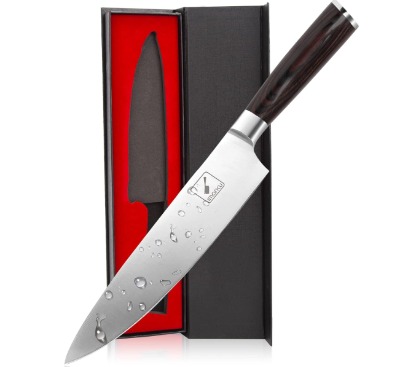
The imarku chef knife is a Japanese-style gyutou that has become incredibly popular — partly because of its performance and partly because of its excellent gift packaging. It comes in a beautiful box, making it one of the best gifts for home cooks of any skill level.
But do not dismiss it as just a pretty gift. The imarku is a well-built knife that delivers strong performance. It uses high carbon stainless steel, has a full tang, and comes with a comfortable ergonomic handle that works well for a wide range of hand sizes.
The blade profile is a hybrid between a western chef knife and a Japanese gyuto — a slight curve toward the tip allows for both rocking and push-cut techniques. This versatility makes it a great daily driver for cooks who do a variety of tasks.
Key Features
High Carbon Stainless Steel The blade is made from German-style high carbon stainless steel (not the harder Japanese steel used in the HOSHANHO). This gives it a good balance between sharpness and durability. It is less prone to chipping than ultra-hard Japanese steel and easier to resharpen.
Hybrid Blade Profile The blade combines the best of both western and Japanese designs. The slightly curved belly works for western rocking cuts. The tapered tip is great for detail work and precision slicing.
Ergonomic Pakkawood-Style Handle The handle is comfortable, well-shaped, and provides a secure grip. It resists moisture better than plain wood and does not feel slippery in use.
Beautiful Gift Box This knife ships in a premium gift box that needs no extra wrapping. It is ready to give right out of the package, which makes it a standout choice for birthdays, holidays, housewarmings, or just showing someone you appreciate them.
Full Tang for Balance The full tang design runs through the handle for solid balance and structural integrity.
Best Use Cases
This knife is a great fit for:
- Gift-givers who want something practical and beautiful
- Home cooks who want a versatile daily driver
- Cooks who want the feel of a Japanese knife without the fragility
- Anyone who does a mix of western and Japanese cooking techniques
Real-Life Usage Insight
The imarku knife is genuinely pleasant to cook with. It arrives sharp and handles a wide range of kitchen tasks without complaint. Chicken breasts, root vegetables, herbs, and bread loaves (with a rocking technique) all get handled cleanly.
The handle is where a lot of users feel the difference. It sits comfortably in a pinch grip and does not fatigue the hand during long prep sessions. For someone cooking dinner for a family every night, that kind of comfort adds up.
The gift box is a real highlight. It genuinely looks like a premium purchase. The knife sits in a molded insert inside an elegant box. There is no need to do anything extra — just wrap it or hand it over as-is.
Performance
Solid across the board. The edge out of the box is sharp and ready to use. The blade angle (around 15 degrees per side) is sharper than a traditional western knife but less extreme than ultra-thin Japanese blades, which makes it easier to maintain.
Edge retention is good for a high carbon stainless steel blade. Regular honing keeps it sharp between sharpenings. When it does need resharpening, it responds well to a whetstone or pull-through sharpener.
Ease of Use
The hybrid blade profile is one of the easiest to use for a wide range of techniques. The slight curve allows rocking chopping (great for herbs and garlic) and the thin tip handles detailed work well. It does not have the learning curve of an ultra-thin Japanese blade.
The handle suits a range of hand sizes and feels natural without any adjustment period.
Value for Money
Excellent, especially considering the gift packaging. You are getting a quality knife and a premium gift experience in one purchase. As a standalone knife purchase, it is competitive with other mid-range options.
Pros
- Versatile hybrid blade profile for various cutting styles
- Sharp out of the box and easy to resharpen
- Beautiful gift box — no extra wrapping needed
- Comfortable ergonomic handle
- Full tang for balance
- Works for both western and Japanese techniques
Cons
- Not as hard or as sharp as pure Japanese steel knives
- Handle material may not appeal to purists
- Mid-range knife market is crowded — it can be hard to stand out
- Requires hand washing for longevity
4. Mercer Culinary M22608 Millennia Black Handle, 8-Inch Chef’s Knife

What Is This Knife?
Mercer Culinary is a name that comes up constantly in professional cooking education. Their knives are the go-to choice in culinary schools across the country, and for good reason. The Millennia line, including this 8 inch chef’s knife, is designed specifically for those who need a reliable, hard-working blade at a low cost.
The Millennia uses a stamped blade from high carbon German steel, a textured polypropylene handle with a Santoprene finger point, and a price tag that makes it accessible to anyone. This is a working knife, not a showpiece. But in a kitchen, that is exactly what you need.
Key Features
High Carbon German Steel Blade The steel is sourced from Germany and offers good sharpness and corrosion resistance. It is slightly softer than Japanese steel, which means it is easier to resharpen but may need more frequent honing. The upside is that it is very unlikely to chip.
Textured Polypropylene Handle with Santoprene Inserts The handle combines a rigid polypropylene base with softer Santoprene inserts. This creates grip points that resist slipping even when hands are very wet. The handle is comfortable for long use and suits a wide range of hand sizes.
NSF Certified The Millennia line is NSF certified, which means it meets the food safety standards required in professional kitchens. It is also built to handle the demands of commercial kitchen use, which speaks to its durability.
Taper Grind Blade The blade has a taper grind edge that allows for flexibility and reduces resistance during cutting. It is not as refined as a forged blade grind, but it performs well above its price point.
Lightweight Design The Millennia is one of the lighter knives on this list. Some cooks love that — it reduces hand fatigue during long prep sessions. Others prefer more heft. This is largely personal preference, but it is worth noting.
Best Use Cases
This knife is a strong choice for:
- Culinary students who need a school-approved, budget-friendly blade
- Home cooks who want a reliable backup knife
- Households with multiple cooks who each want their own blade
- Anyone who wants a hard-working knife without a high upfront investment
- Professional kitchens that need to stock multiple blades on a tight budget
Real-Life Usage Insight
The Mercer Millennia is the kind of knife that shows up, does its job, and does not ask for much in return. It handles all the standard kitchen tasks — dicing onions, breaking down whole chickens, chopping herbs, slicing proteins — without any drama.
The grip is genuinely excellent. The Santoprene inserts provide real tactile feedback and a secure hold. Even with wet hands after washing produce or handling fish, the knife stays firmly in control.
Because it is a lighter, stamped blade, it does not have the same authoritative feel as a heavier forged knife. But for everyday cooking tasks, that matters less than you might think. The knife cuts well, stays reasonably sharp, and gets the job done.
In culinary schools, this knife gets put through serious paces by students who are still learning proper knife technique. The fact that it holds up in that environment says a lot about its durability.
Performance
Performance is solid for the price. The edge comes sharp and performs well on most cutting tasks. Because the steel is slightly softer, it benefits from regular honing — ideally before each use. When it dulls, it resharpens easily with almost any sharpening method.
It is not the knife you reach for if you want ultra-thin cucumber slices or paper-thin beef. But for 95% of what a home cook does daily, it delivers.
Ease of Use
Very easy to use. The lightweight design reduces fatigue. The grip is accessible for beginners and comfortable for experienced cooks. There is no learning curve here — you pick it up and start cooking.
The balance is toward the handle, which many beginners find reassuring. It does not feel like the blade is pulling your hand forward during cuts.
Value for Money
Outstanding. The Mercer Millennia is one of the best values on this entire list. For the price, you get a reliable, safe, NSF-certified kitchen knife that will serve you well for years if you treat it reasonably well.
Pros
- Very affordable — excellent entry-level price
- NSF certified for food safety
- Non-slip textured handle with Santoprene inserts
- Lightweight and easy to maneuver
- Used and trusted in culinary schools
- Easy to resharpen
- Good corrosion resistance
Cons
- Softer steel means more frequent honing needed
- Not as sharp out of the box as Japanese-style knives
- Stamped blade, not forged
- Less impressive aesthetically
- Handle feels more utilitarian than premium
5. PAUDIN Chef Knife, 8 Inch High Carbon Stainless Steel

What Is This Knife?
PAUDIN is a relatively young brand that has quickly built a loyal customer base by delivering attractive, capable knives at competitive prices. The 8 inch chef knife from PAUDIN combines a high carbon stainless steel blade, a comfortable ergonomic handle, and gift-friendly packaging into a package that is hard to ignore.
This knife sits in an interesting middle ground. It is not as utilitarian as the Mercer or Victorinox, and it is not as sharply focused on precision as the HOSHANHO. Instead, it aims to be a well-rounded, attractive, everyday knife that looks good in the kitchen and performs reliably across a range of tasks.
The blade has a subtle hammered or textured finish on some variants, which reduces food sticking during cuts. The handle is made from ABS material with a comfortable grip shape and a bolster for finger protection.
Key Features
High Carbon Stainless Steel Blade The blade uses German-style high carbon stainless steel with a hardness of around 56-58 HRC. This sits in the mid-range for hardness — sharper and harder than a cheap knife, but not as hard as premium Japanese steel. The result is a blade that takes a good edge, holds it well enough for everyday use, and does not chip easily.
Ergonomic Handle with Full Tang The handle is shaped to fit the hand naturally. The full tang provides good balance and structural strength. The ABS material is durable, easy to clean, and resistant to moisture.
Gift-Ready Packaging Like the imarku, the PAUDIN arrives in a nice gift box. It is well-presented and looks like a premium purchase even before you open the box. This makes it a strong choice for gift-givers.
Finger Guard Bolster The bolster (the thick piece of metal between the blade and the handle) acts as a finger guard, keeping your fingers away from the blade during cutting. This is a safety feature that beginners especially appreciate.
Polished Blade with Reduced Food Sticking The blade geometry and finish help reduce the tendency for food to stick to the flat of the blade during cutting. This is a practical feature that makes working with starchy vegetables and proteins a little easier.
Best Use Cases
This knife is well-suited for:
- Home cooks who want an attractive, capable everyday knife
- Gift-givers who want something that looks as good as it performs
- Families who need a reliable kitchen knife that handles a variety of tasks
- Restaurant cooks who need a solid backup blade
Real-Life Usage Insight
The PAUDIN impresses right out of the box. The blade arrives sharp and the fit and finish are clean. It handles the full range of kitchen tasks well — from slicing raw chicken to breaking down butternut squash to chopping a pile of herbs.
The ergonomic handle stands out in daily use. It sits naturally in the hand and the finger guard gives extra confidence during busy cooking sessions. The balance feels slightly blade-forward, which gives it a more authoritative feel during push cuts and chopping.
The gift box is elegant without being over-the-top. It presents well as a birthday or housewarming gift, and the knife inside lives up to the packaging.
One thing worth noting: the blade does an above-average job of releasing food as you cut. Sliced cucumbers and potatoes do not cling to the blade as much as they do on some other knives, which is a small but genuinely useful quality of life improvement during meal prep.
Performance
The performance lands solidly in the mid-range. It is sharper out of the box than the Mercer and holds its edge for a reasonable amount of time. It does not quite match the raw sharpness of the HOSHANHO, but it is more versatile and more forgiving on harder foods.
With regular honing and occasional sharpening, this knife can deliver consistent performance for a long time. It responds well to most sharpening methods, including whetstones and pull-through sharpeners.
Ease of Use
The PAUDIN is designed to be user-friendly. The ergonomic handle encourages proper grip, the bolster protects fingers, and the balance point suits both beginner and intermediate cooks. It does not ask much from the user in terms of technique.
The weight sits in a comfortable middle ground — not too light to feel cheap, not too heavy to cause fatigue. Most cooks will find the right grip immediately without any adjustment period.
Value for Money
Very good. The PAUDIN offers solid performance, attractive aesthetics, and gift-ready packaging at a competitive price. It is not the cheapest option on this list, but the added features and presentation justify the cost.
Pros
- Sharp out of the box with good edge retention
- Attractive design that looks great in the kitchen
- Excellent gift packaging
- Ergonomic handle with finger guard bolster
- Full tang for good balance
- Food releases cleanly from the blade
- Versatile across many cutting tasks
Cons
- Not as sharp as ultra-thin Japanese blades
- ABS handle may feel less premium than wood or resin
- Mid-range steel (not the highest hardness available)
- Brand is newer — less long-term track record than Victorinox or Mercer
Head-to-Head Comparison: How Do These Knives Stack Up?
Now that we have gone deep on each knife, let’s compare them side by side across the key factors.
Sharpness Out of the Box
Winner: HOSHANHO
The HOSHANHO wins on sharpness. Its Japanese high carbon steel and thin grind give it the keenest edge right out of the box. The imarku and PAUDIN follow close behind. The Victorinox and Mercer are sharp enough for everyday use but do not have the same razor-like initial edge.
Edge Retention
Winner: HOSHANHO (with a note)
Harder steel holds an edge longer — but it can also chip. The HOSHANHO holds its edge best on soft to medium-density foods. The Victorinox and Mercer edges dull a bit faster but are easier to touch up.
Handle Comfort
Winner: Tie between Victorinox and Mercer
Both the Victorinox Fibrox and the Mercer Millennia have exceptional non-slip handles. They are the safest options for wet-hand cooking. The PAUDIN and imarku handles are comfortable but less textured. The HOSHANHO handle is ergonomic but slightly more slippery when very wet.
Ease of Maintenance
Winner: Mercer
The Mercer’s softer steel is the easiest to resharpen. The Victorinox is a close second. The HOSHANHO requires the most care — it needs a proper whetstone and careful angle maintenance.
Best for Gifts
Winner: imarku
The gift box on the imarku is the best of the bunch. The PAUDIN is a strong second. Both look premium and present beautifully.
Best Overall Value
Winner: Victorinox Fibrox Pro
For pure value — performance relative to price — the Victorinox wins. The Mercer is a close second, especially for budget shoppers.
Buying Guide: What to Look for in an 8 Inch Chef Knife
Before you pull the trigger on any knife purchase, here are the key things to think about.
Blade Material
This is where most of the confusion starts. You will see terms like “high carbon stainless steel,” “German steel,” “Japanese steel,” and “VG-10.” Here is a simple breakdown:
German Steel (like Wüsthof, Henckels, Mercer, Victorinox): Slightly softer, more durable, easier to sharpen, very corrosion-resistant. Great for everyday home cooking.
Japanese Steel (like HOSHANHO, imarku gyuto): Harder, sharper edge, better edge retention on soft foods, but slightly more brittle. Great for precision cutting and those who want the sharpest possible edge.
For most home cooks, German-style steel is the safer, more forgiving choice. For cooks who want the sharpest possible edge and are willing to handle the knife carefully, Japanese steel is very rewarding.
Blade Construction: Forged vs. Stamped
Forged: The blade is hammered or pressed from a single piece of steel. This creates a denser, more consistent grain structure. Forged blades tend to be heavier, better balanced, and more durable. They are also more expensive.
Stamped: The blade is cut from a sheet of steel. Lighter, less expensive, and perfectly adequate for most home cooks. All budget and mid-range knives on this list are stamped.
Handle Material
Plastic/Polypropylene: Durable, easy to clean, very hygienic. Often textured for grip. Not as aesthetically pleasing as wood.
Pakkawood or Composite Wood: A mix of wood and resin. Looks like wood but handles moisture better. Comfortable and attractive.
ABS Plastic: Smooth, durable, and moisture-resistant. Common in mid-range knives.
For a knife that will see daily use in a busy kitchen with wet hands, a textured plastic or rubber handle wins for safety. For a knife displayed on a magnetic strip or block that sees more careful use, wood or composite handles look beautiful and feel great.
Full Tang vs. Partial Tang
Full tang means the blade steel runs all the way through the handle. It is stronger, better balanced, and more durable. All five knives on this list are full tang.
Partial tang (where the steel only extends partway into the handle) is common in very cheap knives and should be avoided if you plan to use the knife daily.
Blade Edge Angle
Western knives are typically sharpened at 20-25 degrees per side. Japanese knives are often sharpened at 10-15 degrees per side. The sharper the angle, the thinner and keener the edge — but also the more fragile.
For most home cooks, a 15-20 degree edge is the sweet spot: sharp enough for excellent cutting performance, durable enough to handle everyday use without constant maintenance.
Weight and Balance
A heavy knife (around 200-230g) feels authoritative and powerful. A lighter knife (150-180g) is less tiring during long prep sessions. Neither is objectively better — it comes down to personal preference and cooking style.
Balance matters too. A knife balanced at the bolster (between blade and handle) offers a neutral, controlled feel. A blade-heavy knife is better for rocking cuts. A handle-heavy knife is better for control during delicate cuts.
Who Should Buy Which Knife?
Here is a quick guide to matching the right knife to the right cook.
You are a complete beginner who wants something reliable and affordable. → Go with the Victorinox Fibrox Pro or the Mercer Millennia. Both are excellent starter knives with non-slip handles and easy maintenance.
You are an intermediate cook who wants a sharper, more refined edge. → The HOSHANHO is your best bet. The jump in sharpness is noticeable and rewarding.
You are buying a knife as a gift. → The imarku or PAUDIN are your best options. Both come in beautiful packaging that looks like a premium gift.
You are a culinary student who needs a school-approved knife on a budget. → The Mercer Millennia is the standard choice. It is affordable, reliable, and widely accepted.
You are an enthusiastic home cook who wants to balance versatility and quality. → The imarku or PAUDIN both hit that sweet spot between precision and accessibility.
Common Mistakes to Avoid When Using and Maintaining Your Chef Knife
Even the best knife becomes a liability if you do not use and care for it properly. Here are the most common mistakes home cooks make — and how to avoid them.
Mistake 1: Putting It in the Dishwasher (Unless Specified Safe)
High heat, harsh detergent, and the mechanical action inside a dishwasher can dull the blade, damage the handle, and cause corrosion. Only the Victorinox Fibrox is listed as dishwasher safe on this list. All others should be hand washed.
Mistake 2: Using a Glass or Ceramic Cutting Board
Glass and ceramic boards are hard on blade edges. They dull knives very quickly. Always use a wooden or plastic cutting board. End-grain wood boards are the gold standard.
Mistake 3: Storing Knives in a Drawer Without Protection
Throwing a chef knife into a kitchen drawer with other utensils chips and dulls the edge fast. Use a knife block, a magnetic strip, or individual blade guards.
Mistake 4: Not Honing Regularly
Honing is not the same as sharpening. A honing steel realigns the edge without removing metal. It keeps a sharp knife sharp. Hone your knife before or after every use, and you will need to sharpen it far less often.
Mistake 5: Using the Knife for the Wrong Tasks
A chef knife is not a cleaver, a bread knife, or a paring knife. Do not use it to hack through large bones, open clamshells, or cut frozen foods. Use the right tool for the right job.
Mistake 6: Waiting Too Long to Sharpen
A dull knife is a dangerous knife. When a blade is dull, you need more force to cut, which increases the risk of slipping. Sharpen when honing no longer restores performance.
Mistake 7: Washing with Cold Water Immediately After Hot Use
Thermal shock can stress the blade. Let the knife cool before washing, and dry it immediately after washing to prevent water spots and rust.
Final Verdict: Which Is the Best 8 Inch Chef Knife?
After going through all five knives in detail, here is where things land.
Best Overall: Victorinox Fibrox Pro Chef’s Knife
It does not look like much. There is no fancy Damascus pattern or premium wood handle. But the Victorinox Fibrox Pro delivers reliable, consistent, professional-grade performance at a price that almost anyone can afford. The non-slip handle is one of the safest designs available. The edge is sharp, holds well, and is easy to maintain. For most home cooks — beginners especially — this is the knife to start with. You will not outgrow it for years, if ever.
Best for Precision and Sharpness: HOSHANHO
If you want the sharpest edge on this list and you are comfortable taking good care of your knife, the HOSHANHO is the standout. The Japanese high carbon steel blade is noticeably sharper than the competition, and the precision you get on fine cuts is genuinely impressive. Just remember — treat it gently and never use it on bones or frozen food.
Best Gift Option: imarku Gyuto Chef Knife
The imarku is a genuinely capable knife that happens to come in a beautiful gift box. It is versatile, comfortable, and sharp enough to impress any home cook. If you are buying for someone else and want them to be thrilled the moment they open the box, this is the pick.
Best Budget Buy: Mercer Culinary Millennia
The Mercer is the ultimate “get the job done” knife. It is trusted in culinary schools for a reason: it is durable, safe, easy to use, and very affordable. For students, budget-conscious shoppers, or anyone who needs a reliable backup blade, the Mercer delivers more than its price suggests.
Best All-Rounder with Style: PAUDIN Chef Knife
The PAUDIN threads the needle between aesthetics and performance. It is attractive, well-built, and versatile. The ergonomic handle and finger guard make it accessible for beginners, and the sharp blade satisfies more experienced cooks. The gift packaging is a bonus.
Frequently Asked Questions
Is an 8 inch chef knife the right size for me? For most home cooks, yes. The 8 inch length handles everything from large onions to whole chicken breasts comfortably. Smaller cooks or those with smaller kitchens sometimes prefer a 6 inch knife. Professional chefs often use 10 or 12 inch blades for volume work.
How often do I need to sharpen my chef knife? With regular honing, most home cooks only need to sharpen their knives every few months to once or twice a year. The frequency depends on how often you cook and what you cut.
Can I use a pull-through sharpener on these knives? Yes, for most of these knives. Pull-through sharpeners work fine on western-style blades (Victorinox, Mercer, PAUDIN, imarku). For the HOSHANHO’s harder Japanese steel, a whetstone gives better results and is gentler on the edge.
What cutting board should I use with my chef knife? Use a wood or plastic board. End-grain wood is ideal — it is gentle on edges and self-healing. Avoid glass, ceramic, marble, and bamboo boards.
Are expensive chef knives worth it? Not always. The law of diminishing returns kicks in quickly with knives. Most home cooks get 90% of the benefit from a $30-$80 knife that they would from a $300 knife. The difference is mostly in materials, fit and finish, and prestige — not in daily cutting performance.
Wrapping Up
Finding the best 8 inch chef knife does not have to be complicated. Once you understand what you need — sharp edge, comfortable handle, durable construction, easy maintenance — the choice becomes much clearer.
All five knives on this list earn their place. The Victorinox is the reliable workhorse. The HOSHANHO is the precision instrument. The imarku is the perfect gift. The Mercer is the budget champion. The PAUDIN is the stylish all-rounder.
Pick the one that fits your cooking style, your budget, and your kitchen. Then invest a little time in proper care — hand wash it, hone it regularly, store it safely, and sharpen it when needed.
Do that, and your knife will serve you well for many years to come.
Happy cooking.

Hi, I’m Mary, the founder of KitchenClue.com. I’m deeply passionate about everything that makes a kitchen smarter, easier, and more enjoyable. I share hands-on insights and practical expertise on kitchen gear that truly helps in daily cooking. Along with my dedicated research team, we study products carefully, and our writers create honest, well-tested reviews using trusted, authentic sources—so you can choose kitchen tools with total confidence.