End Grain vs Edge Grain Cutting Boards
If you’re shopping for a new cutting board, you’ve probably noticed two main types: end grain and edge grain. They look different, feel different, and cost different amounts. But what’s the actual difference between them? And which one should you buy for your kitchen?
The short answer? It depends on what you need. But let’s dive deeper so you can make the best choice for your cooking style and budget.
What Is a Cutting Board Anyway?
Before we get into the differences, let’s talk about what makes a cutting board special. A cutting board is that flat surface you use to chop vegetables, slice meat, and prepare your food. It needs to be hard enough to handle your knife, soft enough not to dull your blade, and stable enough that it doesn’t slip all over the countertop.
Most people use plastic or wood. Bamboo is also popular. But when it comes to wood cutting boards, there are two main construction methods. The type you pick changes everything about how your board looks, how long it lasts, and how much money you’ll spend.
The Basics: What Is Grain Direction?
Here’s where things get interesting. Wood is made of fibers that run in a specific direction. Think of it like the fibers in a rope. When you cut perpendicular to those fibers, you’re cutting the wood differently than when you cut along them.
A grain is basically the direction that wood fibers run. Wood is made of living trees, and those fibers grew in a certain pattern. After the tree is cut down and dried, those fiber patterns remain.
This matters a lot for cutting boards because your knife hits the wood at different angles based on the grain direction. And that makes a huge difference in how the board wears over time.
What Exactly Is End Grain?
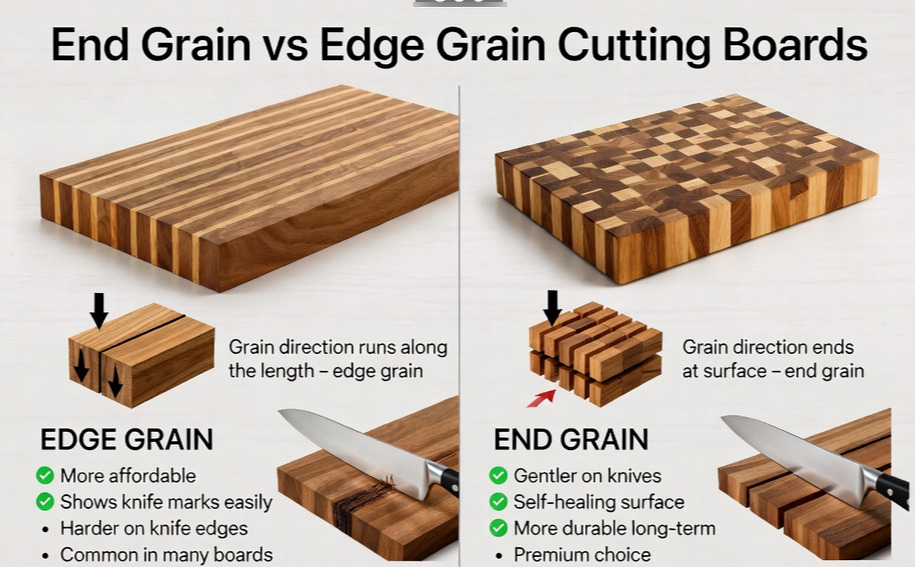
End grain cutting boards are made by arranging wood pieces so that the end of the wood fibers face up. Think about cutting a log of firewood. When you look at the cut surface, you see all those little circles and rings. That’s the end grain.
When you make an end grain cutting board, woodworkers take small blocks of wood and glue them together. The tops of those blocks point up. So when you look down at the board from above, you see thousands of tiny wood circle ends.
End grain boards are made by:
- Taking solid wood and cutting it into small blocks
- Arranging those blocks so the end of the grain faces up
- Gluing them all together with food-safe adhesive
- Sanding and finishing the top surface smooth
This construction method takes more time and skill. It also uses more glue. But the result is worth the effort.
What Exactly Is Edge Grain?
Edge grain cutting boards work differently. In these boards, the long side of the wood grain faces up. Imagine taking a piece of plywood or a wooden board and looking at the narrow edge. That’s the edge grain.
When woodworkers make an edge grain board, they:
- Take long strips of wood
- Arrange them side by side
- Glue them together along their long edges
- Sand and finish the top surface
The grain lines run parallel to each other across the board. If you look at the top of an edge grain board, you’ll see long striped lines running across it. These stripes show you how the wood strips are arranged.
Edge grain boards are simpler to make than end grain boards. They use less glue and less wood. That’s why they cost less money.
The Key Differences Between Them
Now that you know how they’re made, let’s talk about what that means for everyday use.
Durability and Knife Safety
This is the biggest difference between the two types.
When you cut on an end grain board, your knife blade hits all those little wood fiber ends. The fibers move slightly when your blade hits them, then they move back. It’s like pushing your finger into a sponge. The sponge gives a little, then pops back.
This flexibility is amazing for your knives. Your blade doesn’t get shocked by hitting a super hard surface. The impact is softer and easier on the edge. Over time, this means your knife stays sharp longer.
On an edge grain board, your knife hits the long grain side. Think of it like hitting a wooden stick with the grain versus hitting it against the grain. The edge grain is harder and doesn’t give as much. Your knife hits it with more shock and force. This dulls your blade faster.
If you love your knives and want them to stay sharp longer, end grain is the clear winner.
Board Longevity
Here’s something interesting: end grain boards actually last longer too.
When you use a cutting board over and over, you cut into it slightly. You create little scratches and grooves. On an edge grain board, these grooves run along the grain. Water and food can settle into these grooves. Over time, the wood can swell, crack, or warp as it absorbs moisture.
On an end grain board, the grain is arranged differently. Grooves don’t run along the grain in the same way. The grain pattern means that moisture doesn’t get trapped as easily. The board resists warping and cracking better.
An end grain board can last decades if you care for it properly. An edge grain board typically lasts several years to a decade, depending on how much you use it.
The Look
They look completely different, and that matters if you care about kitchen aesthetics.
End grain boards have a beautiful, intricate pattern. All those little wood circles create a stunning checkerboard or mosaic look. They’re almost like art. Many people display their end grain boards on the counter because they look so good.
Edge grain boards have a simpler, striped look. They’re more understated and clean. Some people prefer this look because it’s less busy. It blends into a modern kitchen better.
Both can be pretty. It really depends on your taste.
Weight and Size
End grain boards tend to be heavier because they’re made from more solid wood. They have less air space between the fibers. This extra weight actually helps them stay stable on your counter.
Edge grain boards are lighter because they’re made from thinner strips of wood. This can be a benefit if you move your board around a lot or if you have a small kitchen with limited space.
Cost
This is probably the most important difference for most people’s wallets.
End grain boards are expensive. A quality end grain board can cost $100 to $300 or more. Some high-end boards cost even more. The labor involved in cutting and gluing all those blocks adds up. The wood quality is usually higher too.
Edge grain boards are much cheaper. You can find a good one for $30 to $80. Sometimes even less. The simpler construction means lower prices.
This is a big deal if you’re on a tight budget.
Comparing the Two: A Side-by-Side Look
Let’s put them side by side so you can see all the differences clearly.
End Grain Boards:
- Knife-friendly: Yes, very much
- Long-lasting: 20+ years with care
- Beautiful appearance: Yes, intricate pattern
- Heavy and stable: Yes
- Cost: $100 to $300+
- Easy to maintain: Somewhat harder
- Construction: Complex, labor-intensive
- Best for: Knife lovers, long-term investment
Edge Grain Boards:
- Knife-friendly: Not as much
- Long-lasting: 5 to 10 years
- Beautiful appearance: Yes, but simpler
- Heavy and stable: Less stable, lighter
- Cost: $30 to $80
- Easy to maintain: Easier
- Construction: Simple, quick
- Best for: Budget-conscious cooks, casual use
Making the Right Choice for Your Kitchen
So which one should you get? Here are some questions to ask yourself.
Do you own expensive knives that you want to protect?
If you have quality kitchen knives that cost real money, an end grain board is the smart investment. Keeping your knives sharp saves you money over time. You won’t need to sharpen them as often. A $150 board that keeps a $100 knife sharp is actually a good deal.
Are you a serious home cook?
If you cook every day and use your cutting board constantly, end grain is worth the investment. The board will last longer and protect your equipment better. It’s the right tool for the job.
Do you have a tight budget?
If money is tight, an edge grain board is a perfectly good choice. It works fine for casual cooking. You’ll dull your knives a bit faster, but you can sharpen them. You’ll need to replace the board sooner, but that’s okay if you’re not spending much on it.
Do you like modern, minimal kitchen design?
Edge grain boards fit better into contemporary kitchens. End grain boards make more of a visual statement. If you want your cutting board to fade into the background, edge grain might be better.
Do you have limited counter space?
If you’re in a small kitchen, a lighter edge grain board might work better. You can store it more easily and move it around without strain.
Are you going to display your cutting board on the counter?
End grain boards are beautiful enough to display. Many people leave them out as part of their kitchen décor. If that appeals to you, an end grain board is worth the extra cost.
How to Use and Care for Your Board
Whichever type you choose, proper care matters a lot.
Cleaning Your Board
Wash your board by hand with warm water and mild soap. Never put a wood board in the dishwasher. The heat and moisture will damage it.
Scrub it with a soft brush or cloth. Get into any grooves. Rinse it thoroughly with clean water. Dry it immediately with a clean towel.
This applies to both end grain and edge grain boards.
Oiling Your Board
Wood boards need oil to stay healthy and prevent moisture from getting in. You should oil your board regularly.
Use food-safe mineral oil or specialized cutting board oil. Apply a thin layer all over the board. Let it sit for a few hours or overnight. Wipe off any excess.
Do this once a month for heavily used boards. Do it every three to six months for casual use.
Oiling keeps your board from drying out and cracking. It also helps prevent bacteria growth.
Avoiding Damage
Don’t soak your board in water. Don’t leave water standing on it. Don’t use it as a serving board (moisture from food can damage it). Don’t put it in direct sunlight for long periods.
Avoid cutting frozen food on your board. The cold and hard surface can crack the wood. Let frozen items thaw first.
Store your board standing up on its edge, not flat. This helps air circulate and prevents warping.
The Money Question: Is End Grain Worth It?
Let’s be real about the cost difference.
An end grain board costs roughly 3 to 5 times more than an edge grain board. That’s a significant difference. So is it worth it?
For some people, absolutely yes. If you cook regularly and care about your knives, the investment pays off. Your knives stay sharper longer. Your board lasts longer. Over time, you spend less on knife maintenance and board replacement.
For other people, maybe not. If you cook occasionally and don’t mind sharpening your knives more often, an edge grain board does the job. You save money upfront.
The real question is: what are your priorities? Money now or money saved later? A pretty kitchen or a functional one? Knife protection or casual use?
There’s no wrong answer. It depends on your situation.
Hybrid and Alternative Options
If you can’t decide, there are other choices.
Hybrid Boards
Some manufacturers make boards that are part end grain and part edge grain. These give you some of the benefits of each type. They’re a middle ground in price and appearance.
These can be good if you want something that’s not quite as expensive as full end grain but better than basic edge grain.
Bamboo Boards
Bamboo is technically a grass, not wood. But it’s often used for cutting boards. Bamboo boards are harder than many wood boards. They’re also cheaper than end grain wood boards.
The downside? Bamboo is harder on your knives. It dulls blades faster than even edge grain wood. But if you like the look and don’t mind sharpening your knives, bamboo works.
Plastic Boards
Plastic cutting boards are cheap and dishwasher safe. They don’t dull knives as much as you might think. But they don’t look as nice, and many people don’t like using them.
Some plastic boards absorb bacteria more easily than wood. So the safety benefit isn’t as clear as you might expect.
What Professional Chefs Use
If you’re wondering what the pros prefer, most professional kitchens use wood cutting boards. Many specifically use end grain boards or similar thick wood surfaces.
Why? Because professional chefs care about their knives. They sharpen them regularly, but they also protect them. An end grain board does both things at once.
This tells you something about which type is better for serious cooking.
Common Myths About Cutting Boards
Let’s clear up some confusion.
Myth: Wood boards have more bacteria than plastic boards
False. Wood actually resists bacteria better than plastic. Even used wood boards have been shown in studies to be cleaner than plastic boards. Wood has natural antibacterial properties.
Myth: You can’t use an end grain board for raw meat
False. You can use any wood board for any food, as long as you clean it properly. Both end grain and edge grain boards are safe for raw meat preparation.
Myth: Plastic is more sanitary than wood
False. This is the opposite of what science shows. Wood boards are just as safe as plastic, and many studies suggest they’re safer.
Myth: You only need one cutting board
You don’t need different boards for different foods if you clean properly. But having two boards (one for veggies and one for meat) is a good practice. It’s not necessary, though.
Myth: End grain boards don’t need oiling
False. All wood boards need regular oiling. Even end grain boards.
The Bottom Line
End grain and edge grain cutting boards are both good. They’re just good in different ways.
End grain boards are the premium option. They protect your knives better, last longer, and look more beautiful. If you love cooking and care about your kitchen tools, they’re worth the money.
Edge grain boards are the practical option. They work fine for everyday cooking, cost less, and take up less space. If you’re just getting started or cooking casually, they’re a great choice.
Think about your cooking habits, your budget, and what matters to you. Then pick the board that fits your life.
One more thing: whichever board you choose, use it and enjoy it. A cutting board isn’t just a tool. It’s part of your kitchen story. Take care of it, and it will take care of you.
Quick Buying Tips
Before you shop, keep these tips in mind.
Buy from reputable makers. Quality matters. Cheap cutting boards of either type tend to warp and crack. Spend a bit more and get something that will last.
Look at the wood type. Different woods have different properties. Maple is hard and beautiful. Walnut is softer but looks gorgeous. Bamboo is super hard. Ask the maker what wood they used.
Check for food-safe finishes. Make sure any finish or oil on the board is food-safe. You’ll be eating food that touches it.
Consider thickness. A thicker board is more stable and lasts longer. Aim for at least 1.5 inches thick.
Look at size. A bigger board gives you more working space. But it takes up more storage room. Think about your kitchen situation.
Check the warranty. Good makers stand behind their boards. A warranty is a good sign.
Read reviews. See what other people say about the board. Real user experiences matter.
Final Thoughts
The end grain versus edge grain question doesn’t have a single right answer. Both types have their place in different kitchens.
The important thing is understanding what you’re getting when you buy. Now you know the difference. You know what each type does well. You know what matters for your situation.
That knowledge lets you make a smart choice. And a smart choice means you’ll be happy with your board for years to come.
Whether you go with the beautiful, expensive end grain board or the practical, affordable edge grain board, you’re making a good choice if it fits your needs.
Now go find the perfect cutting board for your kitchen. Your knives will thank you.

Hi, I’m Mary, the founder of KitchenClue.com. I’m deeply passionate about everything that makes a kitchen smarter, easier, and more enjoyable. I share hands-on insights and practical expertise on kitchen gear that truly helps in daily cooking. Along with my dedicated research team, we study products carefully, and our writers create honest, well-tested reviews using trusted, authentic sources—so you can choose kitchen tools with total confidence.