Le Creuset Dutch Oven Round Vs Oval: Which Is Best?
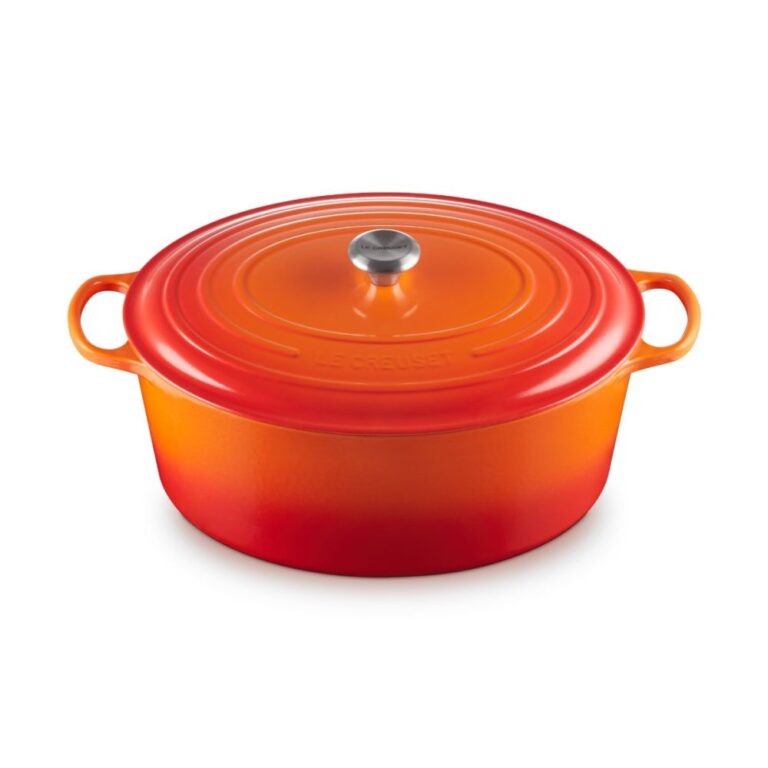
For most cooks in the United States, a round Le Creuset Dutch oven is the better all-purpose choice. It heats well on common round burners, suits soups and stews, and is easier to store. Choose an oval Dutch oven when you often cook whole chickens, roasts, brisket, ribs, or other long foods that do not fit well in a round pot.
The best shape depends less on capacity and more on what you cook, the size of your stovetop burners, and how much storage space you have. Both shapes use Le Creuset’s enameled cast iron and can move from the stovetop to the oven, but their cooking surfaces work differently.

Round vs. Oval Le Creuset Dutch Oven: Quick Answer
A round Dutch oven is the strongest choice for daily cooking. Its base matches most American gas, electric, and induction burners. This helps the pot heat in a more even and predictable way.
An oval Dutch oven gives you more length. That extra room helps with foods such as a whole chicken, pork loin, leg of lamb, or a long rack of ribs.
| Feature | Round Dutch oven | Oval Dutch oven |
|---|---|---|
| Best for | Soups, stews, beans, bread, braises | Whole poultry, roasts, ribs, long cuts |
| Burner fit | Usually better on round burners | May extend beyond a round burner |
| Heat pattern | More even match with most burners | Can heat more at the center than the ends |
| Storage | Easier to fit in cabinets | Needs more shelf length |
| Everyday use | Usually more convenient | More specialized |
| Shape of cooking area | Compact and deep | Long and often slightly shallower |
| Best first purchase | Yes, for most households | Yes, if long foods are common |
Simple rule: Buy round for flexibility. Buy oval for length.
What Makes Le Creuset Round and Oval Dutch Ovens Different?
Both types are heavy, enameled cast-iron pots. The main difference is the shape of the cooking surface, not the basic material.
Le Creuset’s cast iron holds heat well after the pot becomes hot. The enamel coating gives you a smooth cooking surface without the seasoning process needed for bare cast iron. It also makes the pot useful for acidic foods such as tomato sauce, wine-based braises, and many stews.
The shape changes how heat reaches the food. A round pot often matches the hot area of a household burner. An oval pot spreads the same heat over a longer base. If the burner is round, the center may heat faster than the ends.
That does not make an oval pot unsafe or unsuitable. It means you should use low or medium heat and allow extra time for the pot to warm. A thick cast-iron pot should not be heated empty over high heat.
Le Creuset makes both shapes in several sizes. Exact sizes, colors, handles, and prices can change by model and market, so check the current US product page before buying.

Cooking Performance: Does Round Heat Better Than Oval?
A round Dutch oven often heats more evenly on a typical US stovetop because its base matches a round burner more closely. This matters most when you sauté onions, brown meat, or reduce a sauce directly in the pot.
An oval Dutch oven can still cook very well. The main limit appears when the heat source is smaller than the base. The center may brown food first, while the ends warm more slowly. You can reduce this difference by:
- Preheating on low to medium heat.
- Adding food only after the pot warms gradually.
- Turning or moving food during browning.
- Using the oven for long, gentle cooking.
- Avoiding high heat to “speed up” preheating.
- Checking that the pot sits securely on the burner.
Stovetop performance
Round is usually more convenient for:
- Searing small batches of beef or chicken.
- Frying aromatics.
- Cooking rice, beans, and grains.
- Making soup or chili.
- Baking round loaves of bread.
- Cooking on a small burner.
Oval is useful when the food itself is long. A whole chicken may fit more naturally in an oval pot, with less bending or crowding. That can make browning and arranging the food easier.
Oven performance
The difference becomes smaller in the oven. Hot air surrounds the pot, so the oven does not depend on one round burner heating the center.
An oval pot can be especially practical for covered oven braises. A roast or poultry may sit flat instead of being squeezed into a round vessel. The lid also helps hold moisture during slow cooking.
Still, the pot must fit your oven. Measure the interior width, depth, and rack clearance before buying a large oval model. Include the lid and handles in your measurement.
Which Shape Is Better for Specific Foods?
The food’s length is the clearest reason to choose oval. The cooking method is the clearest reason to choose round.
| Food or task | Better shape | Why |
|---|---|---|
| Soup and chili | Round | The compact shape works well for stirring and burner contact |
| Beans | Round | A round base suits slow stovetop simmering |
| No-knead bread | Round | Many recipes use a round loaf and round pot |
| Whole chicken | Oval | More length helps the bird sit flat |
| Pork shoulder | Either | Round works for smaller cuts; oval helps with long cuts |
| Beef brisket | Oval | The long base reduces folding |
| Short ribs | Oval or round | Oval helps arrange long bones; round works for smaller batches |
| Pasta sauce | Round | Easy to stir and heat on a common burner |
| Large batch stew | Either | Choose by batch size and storage space |
| Deep frying | Round | A compact shape often gives a useful oil depth |
| Casserole-style braises | Oval | The shape suits long cuts and vegetables |
These are practical comparisons, not rules. A large round Dutch oven can hold a whole chicken. A large oval pot can make soup. The question is whether the shape makes the job easier.

Le Creuset Round vs. Oval Size Comparison
Do not compare quart numbers alone. Two Dutch ovens with similar capacities may have different usable shapes. One may be deeper, while the other may be longer and easier for a roast.
Common Le Creuset US sizes include examples such as:
| Approximate capacity | Round use | Oval use |
|---|---|---|
| 3.5 quarts | Small households, side dishes, smaller stews | Small roasts or poultry portions |
| 5 to 5.5 quarts | Everyday soups, braises, beans, bread | Medium roasts and smaller whole chickens |
| 6.75 to 7.25 quarts | Large family meals and batch cooking | Large poultry, brisket, and long roasts |
| 8 quarts or more | Very large batches | Large cuts and holiday cooking |
These capacities are approximate model groupings. Le Creuset offers different collections and shapes, so confirm the exact interior and exterior dimensions.
A useful capacity guide
For a first Dutch oven, many households choose a size around 5 to 6 quarts. It usually gives enough room for a family meal without becoming too heavy or difficult to store.
Choose a smaller pot when:
- You cook for one or two people.
- You make small portions.
- Your oven and cabinets have limited space.
- You want a pot that is easier to lift when full.
Choose a larger pot when:
- You cook for a large household.
- You make stock or large batches of chili.
- You freeze meals.
- You often cook large roasts or whole poultry.
A larger pot is not always better. More empty space can make small meals less convenient, and a full cast-iron pot can be difficult to lift safely.
Which Shape Works Best on Gas, Electric, and Induction Stoves?
A round Dutch oven is usually the simplest option for a standard US stovetop. Its base aligns more closely with round electric elements and gas flames.
An oval Dutch oven needs more attention to burner size. On gas, the flame should stay under the base rather than climb the sides. On electric or induction, the heating area may cover only the center of the pot.
Both enameled cast-iron shapes are generally compatible with induction cooktops because cast iron is magnetic. However, the cooktop maker’s instructions still control. Check the maximum cookware size, surface-care rules, and weight limits.
For glass cooktops:
- Lift the pot instead of sliding it.
- Keep the bottom clean before placing it on the glass.
- Avoid dropping or setting down the pot with force.
- Confirm that the pot sits flat and does not rock.
- Be careful when the pot is full, since its weight increases quickly.
For any cooktop, use the smallest heat setting that maintains the desired cooking temperature. Cast iron stores heat, so turning the burner to high may create more heat than the food needs.

Round or Oval for Bread Baking?
Round is usually easier for round sourdough and no-knead bread. The dough often spreads into a round loaf, and a round pot supports that shape well.
Oval can be better for batards and long loaves. Its length gives the dough room to expand without pressing against the sides of the pot.
The pot must have enough room for the dough to rise. It should also fit safely in the oven with the lid on. Before baking, confirm the maximum oven temperature for the exact lid and knob. Cast-iron lids may have different knob materials, and the allowed temperature can vary by model.
Do not preheat an empty enameled Dutch oven at a very high temperature unless the manufacturer’s instructions clearly allow it. Sudden or excessive heat can stress enamel. Use the care guide for your exact Le Creuset model.
Cleaning and Care for Both Shapes
Round and oval enameled Dutch ovens need nearly the same care. Let the pot cool before washing it. A sudden change from very hot to cold water can damage enamel over time.
Use warm water, dish soap, and a soft sponge. For stuck food, soak the pot first. A paste made with baking soda and water can help with mild stains. Avoid steel wool, harsh scouring pads, and abrasive cleaners that may dull or scratch the enamel.
Other good habits include:
- Do not use metal utensils aggressively against the enamel.
- Do not heat the pot empty for long periods.
- Do not drag it across a glass cooktop.
- Dry the rim and exterior before storing.
- Store the lid slightly open if moisture tends to collect.
- Follow Le Creuset’s care instructions for the exact product.
Oval pots can be harder to clean in a small sink because they need more room to turn. Their longer handles and wider footprint may also need more drying space.

Common Buying Mistakes to Avoid
Choosing by quart capacity alone
Capacity does not tell you how long or wide the cooking area is. Look at the dimensions and think about the food you cook most often.
Buying an oval pot for a small round burner
An oval pot can work on a small burner, but it may heat more slowly at the ends. If most of your cooking happens on the stovetop, round may be easier.
Buying the largest model available
A large Dutch oven takes more space and becomes much heavier when filled. Choose a size you can lift safely from the stovetop to the oven.
Ignoring oven clearance
Measure the oven cavity, rack position, and door clearance. A wide oval pot may fit on the rack but prevent the door from closing.
Using high heat to warm cast iron quickly
High heat can cause uneven heating and increase the risk of food scorching. Start lower and let the pot warm at a controlled pace.
Assuming every lid knob has the same heat limit
Le Creuset uses different knob materials across products. Check the instructions for the exact lid and knob before using a high oven temperature.

Who Should Buy the Round Le Creuset Dutch Oven?
Choose a round model if you want one pot for many jobs. It is the better fit for most first-time buyers, especially those who cook on a standard US stovetop.
Round is a strong choice for:
- Daily soups and stews.
- Beans and grains.
- Braised chicken pieces.
- Tomato-based dishes.
- Sautéing and searing.
- Round loaves of bread.
- Smaller kitchens and cabinets.
- People who want easier burner alignment.
For many households, a medium round Dutch oven offers the best balance of size, flexibility, and storage.
Who Should Buy the Oval Le Creuset Dutch Oven?
Choose an oval model when the shape of the food matters. It is most useful for cooks who often prepare large or elongated cuts.
Oval is a strong choice for:
- Whole chickens and turkeys.
- Brisket and pork loin.
- Leg of lamb.
- Long racks of ribs.
- Large oven braises.
- Batard-style bread.
- Long vegetables or fish.
An oval pot is less of a general upgrade than a specialized tool. If you rarely cook long foods, its extra length may not justify the storage and burner trade-offs.
Frequently Asked Questions
Is a round or oval Dutch oven better for a whole chicken?
An oval Dutch oven usually makes a whole chicken easier to arrange. A round pot can still work if the chicken fits without pressing against the sides or lid.
Does an oval Dutch oven cook unevenly?
It can heat less evenly on a round stovetop burner because the ends extend beyond the strongest heat area. Gradual preheating, moderate heat, and oven cooking reduce this issue.
Can I use an oval Dutch oven on an induction cooktop?
Usually, yes, because cast iron is magnetic. Check both the Le Creuset instructions and your induction cooktop manual for cookware size, weight, and surface-care limits.
Is a 5-quart oval Dutch oven the same as a 5-quart round Dutch oven?
No. The capacity may be similar, but the interior length, width, depth, and cooking area can differ. The oval model may fit long foods better, while the round model may offer a more compact cooking surface.
Which shape is easier to store?
A round Dutch oven is usually easier to store because it takes less shelf length. An oval model may need a wider cabinet or more open shelf space.
Can I bake bread in either shape?
Yes. Round works well for round loaves, while oval works well for longer loaves. Always check the oven limit for the exact lid and knob.
Final Recommendation
For most US kitchens, choose a round Le Creuset Dutch oven first. It offers the best general use on common stovetops and handles soups, beans, braises, sauces, and bread with little compromise.
Choose an oval Le Creuset Dutch oven when you regularly cook whole poultry, brisket, ribs, or other long foods. Before buying, measure your oven, storage shelf, and main burner. The right shape is the one that fits both your cookware routine and your kitchen.
For the final decision, compare the exact model’s capacity, base dimensions, lid knob, oven limit, and care instructions on Le Creuset’s US product page rather than relying on shape or quart size alone.

Hi, I’m Mary, the founder of KitchenClue.com. I’m deeply passionate about everything that makes a kitchen smarter, easier, and more enjoyable. I share hands-on insights and practical expertise on kitchen gear that truly helps in daily cooking. Along with my dedicated research team, we study products carefully, and our writers create honest, well-tested reviews using trusted, authentic sources—so you can choose kitchen tools with total confidence.