Wüsthof Classic vs Gourmet Knife
If you’ve been shopping for kitchen knives, you’ve probably heard about Wüsthof. This German knife company has been around for a very long time and makes some of the best blades in the world. Two of their most popular lines are the Classic and the Gourmet. But which one should you pick? That’s what we’re here to figure out today.
Both of these knife series are great. But they’re different in ways that really matter. By the time you finish reading this guide, you’ll know exactly which knife fits your cooking style and your budget. Let’s jump in.
What Makes Wüsthof Knives Special?
Before we compare these two lines, let’s talk about what makes Wüsthof stand out. This brand comes from Solingen, Germany. That’s a city famous for making high-quality blades. Wüsthof has been crafting knives since the 1800s. They have a long history of excellence.
Wüsthof knives are made with real craftsmanship. Each blade goes through careful steps during production. The company uses special steel alloys that hold edges really well. They also temper the blades to make them strong but not brittle. This means your knife won’t snap or chip easily.
When you buy a Wüsthof knife, you’re buying decades of experience. You’re also buying a tool that will last for years if you treat it right. Many people pass down their Wüsthof knives to the next generation. That says something about quality.
The Classic Line: Built to Last
The Wüsthof Classic is the flagship collection. This is what the company is most famous for. If you see a Wüsthof knife in a professional kitchen, it’s probably a Classic.
Design and Look
Classic knives have a traditional German knife design. The blade curves smoothly from the handle. The handle is made of a special plastic called PakkaWood. This material looks like wood but works way better in kitchens. It doesn’t absorb water or bacteria. It stays comfortable in your hand even when wet.
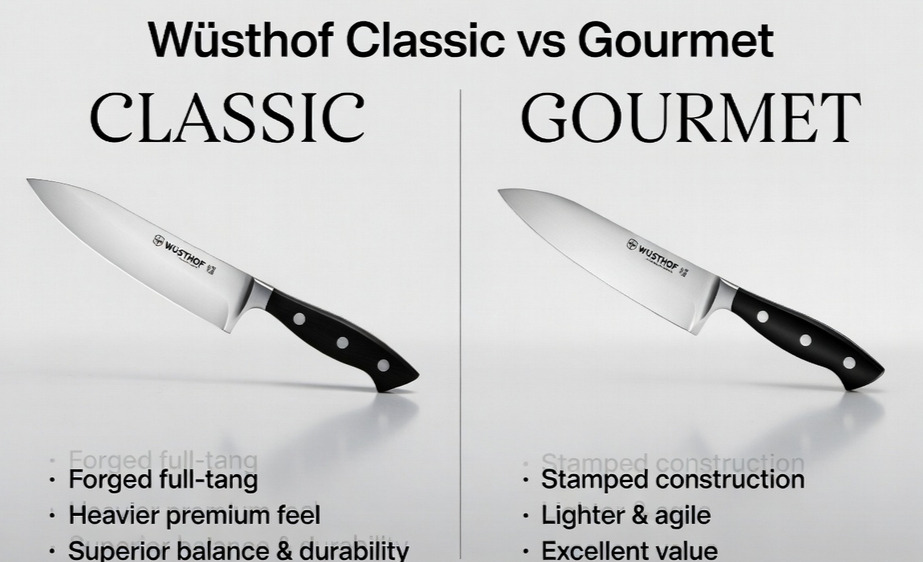
The whole knife is forged from one piece of steel. This means the blade and the handle are connected all the way through. This makes the knife durable and well-balanced.
How They Feel
Hold a Classic knife and you’ll notice the weight. These aren’t light knives. The blade is thick and substantial. The handle is shaped to fit your hand naturally. Many cooks love this solid, hearty feel. It makes you feel like you’re using a real tool.
The balance point sits near the handle. This means most of the weight is at the base of the blade. It gives you control and power when you cut. Professional chefs often prefer this kind of balance.
Edge Performance
Classic knives hold an edge for a long time. The steel is hard and dense. When you sharpen a Classic blade, it stays sharp. You won’t need to sharpen it as often as softer knives.
The edge itself is angled at about 15 degrees on each side. This is a sharp angle. It means the blade slices through food really well. Vegetables, meats, herbs – the Classic handles them all with ease.
Maintenance
Classic knives need a bit more care. They’re not dishwasher safe. You should hand wash them and dry them right away. If you leave them wet, they can rust. The steel is susceptible to water damage if left sitting.
You should also use a honing steel before each use. A honing steel realigns the blade’s edge. It’s not sharpening, but it keeps your knife working great. Think of it like tuning a guitar before you play.
About once a year, you’ll want to get your Classic sharpened by a professional. Or you can learn to sharpen it yourself with a whetstone.
The Gourmet Line: Easier and More Affordable
The Gourmet series is Wüsthof’s way of making great knives accessible to everyone. These aren’t cheap knockoffs. They’re real Wüsthof blades. But they’re designed differently than the Classic.
What Makes It Different
The big difference is how the Gourmet is made. Instead of forging the whole knife from one piece, Wüsthof stamps the Gourmet blade. This is a faster process. It’s also cheaper. But does it make a worse knife? Not really. It just makes a different knife.
The Gourmet handle is also plastic, but it’s a different type. It’s lighter and less expensive than the PakkaWood on the Classic. The handle is still comfortable and durable. It’s just simpler in design.
Weight and Balance
Gourmet knives are lighter than Classic knives. This is by design. Lighter knives appeal to a lot of home cooks. They’re easier to control, especially if you have a small hand. You can work with them longer without your arm getting tired.
The balance point is slightly forward of the Classic. There’s a bit less weight behind the blade. But this doesn’t make them bad. Many people actually prefer this lighter touch.
Sharpness and Edge
Here’s something that surprises people: Gourmet knives come sharp right out of the box. Really sharp. Some people think they’re sharper than the Classic straight away. But the edge doesn’t last as long.
The steel in the Gourmet is softer than the Classic steel. Softer steel doesn’t hold an edge forever. You’ll need to sharpen or hone your Gourmet blade more often. But when you do sharpen it, it takes an edge beautifully.
Easy Care
The Gourmet is more forgiving. You can put these in the dishwasher if you want. We don’t recommend it because hand washing is always better. But the fact that you can is nice. It means your knife survives accidents.
Gourmet knives don’t rust as easily because they have a different steel mix. This makes them more practical for busy home cooks who might not be perfect at knife care.
You can still use a honing steel before each use. But you can also just sharpen them when they get dull. There’s less fussing around.
Side by Side: The Real Differences
Now let’s lay out the main differences in a clear way. This will help you decide which knife is right for you.
Price
This is often the first thing people look at. The Gourmet is cheaper. A Gourmet chef’s knife might run you 50 to 70 dollars. A Classic of the same size? That’s 150 to 200 dollars. That’s a big price gap.
For a home cook starting out, this matters. You might be building your collection. Spending less on your first knife makes sense.
Steel Quality
The Classic uses stainless steel with higher carbon content. This makes it harder and more durable. It holds an edge longer. But it’s also more prone to rust if you don’t care for it.
The Gourmet uses a different stainless steel blend. It’s more forgiving. It rusts less. The tradeoff is that it doesn’t hold an edge quite as long.
How Long It Lasts
A Classic knife, if you care for it right, will last decades. People use the same Classic knife for 20 or 30 years. They pass them down to kids and grandkids.
A Gourmet knife will also last a long time. But you might replace it before a Classic. The lighter construction means it’s not quite as durable over time.
Sharpness Out of the Box
The Gourmet often wins here. These knives arrive razor sharp. You can start chopping right away. The Classic is sharp, but it might need a touch-up first.
How Often You Sharpen
The Classic holds an edge longer. You might sharpen it once a year if you use it daily. The Gourmet might need sharpening every few months. That’s more work, but some people don’t mind.
Feel in Your Hand
The Classic feels heavy and solid. It gives you a sense of control. If you like to feel the weight of your tool, you’ll love it.
The Gourmet feels lighter. It’s quicker to move. If you like a nimble, responsive knife, the Gourmet might be your pick.
Forgiving Nature
The Gourmet is more forgiving. You can be a little sloppy with care and it’ll be fine. The Classic needs better treatment. If you’re careful and deliberate, the Classic rewards you.
Which Knife Should You Get?
This depends on you. Let’s look at different cooking situations.
The Gourmet Is Better If You:
Are just starting out. You don’t know your knife care habits yet. The Gourmet’s forgiving nature is perfect while you learn.
Want to save money. The price difference is real. If you have $70 but not $180, the Gourmet is the right choice. It’s still a fantastic knife.
Cook casually. You make dinner a few times a week but don’t think of yourself as a chef. The Gourmet does everything you need.
Don’t want to fuss. You like simple. The Gourmet lets you use it, toss it in a drawer, and not worry. It’ll still work great next week.
Have small hands. The lighter weight is easier to handle. You can chop for longer without fatigue.
Don’t have much kitchen space. You’re building slowly. Getting one good Gourmet knife now makes sense.
The Classic Is Better If You:
Cook seriously. You spend real time in the kitchen. You enjoy cooking and want tools that match your passion.
Are willing to maintain your knives. You’ll hand wash, dry carefully, and sharpen properly. You take pride in upkeep.
Want something forever. You want a knife that lasts decades. Something you’ll still use in 20 years. The Classic is that knife.
Prefer professional feel. You want your kitchen knives to feel like the ones in fancy restaurants. The Classic gives you that.
Use your knife every day. Daily use means less frequent sharpening is important. The Classic’s longer edge life matters.
Have grown your collection. You already have some knives. Adding a Classic elevates your whole setup.
Have bigger hands. The heavier knife feels better in your palm. You can really control it.
What About Other Wüsthof Lines?
Just so you know, Wüsthof makes other knife lines too. They have a Pro series that’s forged like the Classic but lighter. They have other specialty lines. But for most people, it’s really between Classic and Gourmet.
Building Your Knife Collection
Maybe you’re thinking about buying just one knife. That’s fine. Start with a chef’s knife. This is the most useful knife in your kitchen. An 8-inch chef’s knife does 90 percent of what you need.
After you have a chef’s knife, think about a paring knife. This is small and good for detail work. Then maybe a bread knife. A serrated bread knife cuts through crusty loaves without squishing them.
If you go with the Gourmet, you could get all three for less than one Classic chef’s knife.
How to Use Your Wüsthof Knife Right
No matter which knife you pick, use it correctly. This keeps it working great.
Use a cutting board made of wood or plastic. Never use glass, ceramic, or marble. These will destroy your edge fast. The blade slides off these hard surfaces. You’ll quickly dull your knife.
Use a honing steel regularly. Before you use your knife, run it through a honing steel. This takes 30 seconds. It keeps your edge true. You’ll notice better cutting performance.
Hand wash always. Dishwashers are bad for knife edges. The blade bangs around. The heat and chemicals are hard on the steel. Hand washing takes one minute. Do it.
Dry right away. Don’t let your knife sit wet. Water leads to rust over time. Dry it with a towel as soon as you wash it. Let it air dry fully before putting it away.
Store it properly. A magnetic strip, a knife block, or a knife sheath all work. Don’t throw it loose in a drawer. The blade will bang against stuff. It’ll get dull and might damage the edge.
Don’t use it for tasks it wasn’t made for. Don’t pry open cans. Don’t cut through bones with force. Don’t chop on metal pans. Use your knife for cutting food. That’s it.
Sharpening Your Knife
Eventually, your knife will get dull. That’s normal. Here’s how to bring it back.
Honing is not sharpening. This is a common mix-up. Honing realigns the edge. Sharpening removes metal to create a new edge. You hone before every use. You sharpen once or twice a year.
You can sharpen at home. A whetstone works great. You need to learn the angle and technique. Watch some videos. Practice on an old knife first. Once you learn, it’s very satisfying.
You can send it out. A local sharpening service will do it for you. It costs $10 to $20. Your knife comes back perfect. This is easy if you don’t want to learn.
Real Talk About Price
Is the Classic worth three times the price of the Gourmet?
For a professional chef or serious home cook, yes. The edge retention means less time sharpening. The durability means using the same knife for decades. That adds up.
For a casual cook, no. The Gourmet will do everything you need. You’ll sharpen it more often. That’s not a big deal. You’ll probably replace it sometime. But you’ll save hundreds of dollars.
There’s no wrong answer. It depends on your cooking style and how much you care about this stuff.
What About Maintenance Costs?
Think about the total cost of ownership over time.
A Classic knife might cost $180. Over 25 years, that’s $7 per year. Add sharpening once a year at $15. That’s $22 per year total. That’s incredibly cheap.
A Gourmet knife might cost $60. But you sharpen it four times a year at $15 each. That’s $60 per year just in sharpening. Plus you might buy a new one after 10 years. The total cost starts adding up.
When you look at it this way, the Classic might actually be the better value.
The Verdict
Here’s the simple answer: Both knives are great. You can’t go wrong. But you need to match the knife to your life.
Go with the Gourmet if: You’re just starting your kitchen setup, you have a limited budget, or you don’t want to think about knife care too much. It’s a real knife that will serve you well.
Go with the Classic if: You cook regularly and seriously, you’re willing to care for your tools, or you want something that lasts a lifetime. The investment pays off over time.
A Few Final Thoughts
Knives are funny. People get really passionate about them. Some folks will tell you a Classic is the only way to cook. Others swear by the Gourmet.
The truth is simpler. The best knife is the one you’ll actually use. If you don’t like how it feels, you won’t cook as much. If the price makes you feel bad, you won’t enjoy it.
So think about your cooking habits. Think about your budget. Think about how much you’re willing to maintain a tool. Then pick the knife that fits your life.
Either way, you’re getting a blade from a company with serious history and serious skill. Wüsthof doesn’t make bad knives. They make different knives for different people.
Wrapping Up
The Classic and Gourmet represent two different philosophies. The Classic says: “I’m investing in the best. I’ll care for it and use it forever.” The Gourmet says: “I want a quality knife that doesn’t demand perfection.”
Both philosophies are valid. Both lead to good cooking.
Start with one good knife. Learn to use it well. Learn to care for it. Then, as your collection grows, you might pick up the other line. Many serious home cooks end up with both. A Classic for everyday work and a Gourmet for backup or special tasks.
There’s really no competition between these two knives. They’re not fighting for the same customer. They’re serving different needs. That’s why Wüsthof makes both.
So grab whichever one fits you best. Head to the kitchen. Start cutting. That’s where the real joy of cooking begins.
Quick Reference: The Comparison
| Feature | Classic | Gourmet |
|---|---|---|
| Price | $150-$200 | $50-$70 |
| Forging | Forged one-piece | Stamped blade |
| Handle Material | PakkaWood | Plastic |
| Weight | Heavy | Light |
| Edge Retention | Excellent | Good |
| Rust Resistant | Less | More |
| Maintenance | High | Low |
| Lifespan | 20-30+ years | 10-15 years |
| Best For | Serious cooks | Casual cooks |
| Learning Curve | Medium | Easy |
| Out of Box Sharpness | Sharp | Very sharp |
| Dishwasher Safe | No | Technically yes* |
*We recommend hand washing both, but the Gourmet can survive a dishwasher better.
Start Your Knife Journey Today
Cooking is one of life’s great pleasures. Good tools make it even better. Whether you pick a Classic or a Gourmet, you’re making a smart choice. You’re choosing quality. You’re choosing a German tradition that goes back hundreds of years.
Now get in that kitchen and start cooking. Your new knife is waiting for you.

Hi, I’m Mary, the founder of KitchenClue.com. I’m deeply passionate about everything that makes a kitchen smarter, easier, and more enjoyable. I share hands-on insights and practical expertise on kitchen gear that truly helps in daily cooking. Along with my dedicated research team, we study products carefully, and our writers create honest, well-tested reviews using trusted, authentic sources—so you can choose kitchen tools with total confidence.